Elementary Program Information
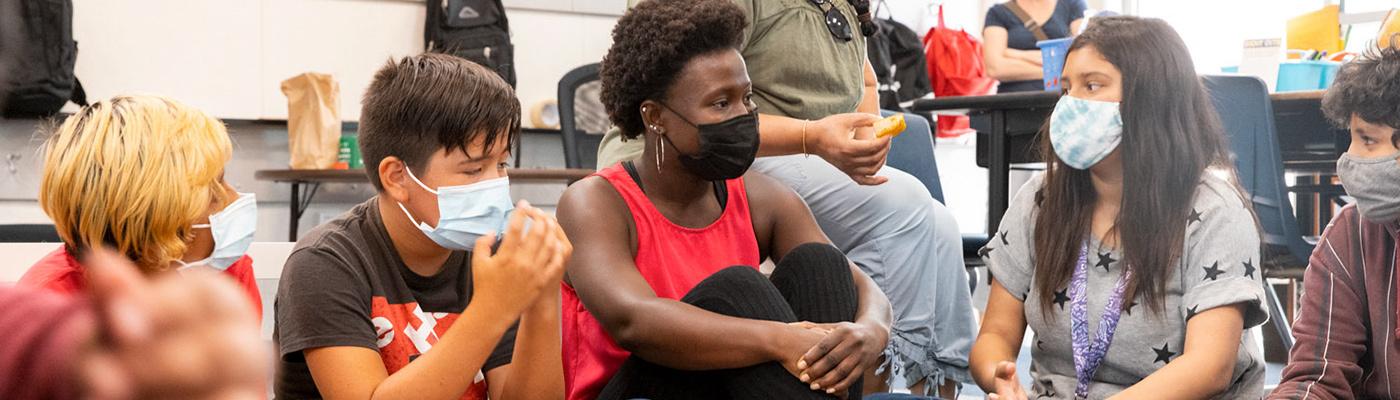
STEP is a full-time, 12-month program that combines theory and practice throughout. Teacher candidates gain classroom experience during the day. In the afternoon, they attend courses, including a weekly seminar designed to foster community and support their growth as educators.
Coursework and field work are designed to prepare graduates to meet the practical and intellectual challenges of the teaching profession, to serve the needs of diverse students, and to take leadership roles in schools and communities.

Elementary overview
STEP elementary teacher candidates take a minimum of 45 units, distributed over four quarters and leading to a master’s in education and a preliminary California multiple subject teaching credential. They may also opt to earn a California Spanish bilingual authorization. Each candidate participates in two to three classroom placements under the supervision of expert cooperating teachers and a university supervisor.
Elementary curriculum and coursework
Many areas of knowledge underlie effective teaching. The course progression is designed both to equip and support candidates with a depth of content knowledge, a repertoire of powerful pedagogical practices, an understanding of and commitment to research, and a view of teaching informed by an appreciation of the socio-cultural contexts of education.
The STEP teaching seminar sits at the nexus of the clinical and academic elements of the program and provides a context for self-reflection and building community within the cohort.
Students who opt to earn a bilingual authorization receive special preparation to teach in bilingual settings.
STEP elementary curriculum calendar
| Summer | PreFall | Fall | Winter | Spring |
| Summer Explorations Supervisory |
Placement 1 Supervisory |
Placement 2 Supervisory |
||
| Elementary Teaching Seminar: Exploring Teaching for Equity, Educational Freedom, & Racial Justice | Elementary Teaching Seminar: Culturally Sustaining School-Family Partnerships | Elementary Teaching Seminar: Assessment for Learning & Equity | Elementary Teaching Seminar: Imagining Forward Health and Wholeness: Intersectionality, Wellness, & Identity in Schools | |
| Child Development, Learning Differences + Inclusive Practices | CDLDIP | CDLDIP | CDLDIP | |
| Building Classroom Community | Language Policies & Practices | |||
| Arts, History & Social Sciences: Integration & Inquiry | Becoming Literate in Schools (BLIS) 1 | Becoming Literate in Schools (BLIS) 2 | Becoming Literate in Schools (BLIS) 3 | Arts, History & Social Sciences: Integration & Inquiry |
| Quantitative Reasoning & Mathematics 1 | Development of Scientific Reasoning & Knowledge | Quantitative Reasoning & Mathematics 2 | Quantitative Reasoning & Mathematics 3 | |
| Métodos y Materiales en los Salones Bilingües |
Métodos y Materiales en los Salones Bilingües |
Métodos y Materiales en los Salones Bilingües |
||
| Schoolin’ the Golden State | AI & Education for Future Teachers | December Workshops (edTPA, Job Search) |
Workshops (edTPA, Job Search) |
Beyond Equity |
| Garden 1 | Garden 2 | Garden 3 | Garden 4 | |
To learn more about course content, view the syllabi below.
- EDUC228H: Arts, History & Social Sciences: Integration & Inquiry | 2026 syllabus
- EDUC246E: Elementary Teaching Seminar I 2026 syllabus
- EDUC263E: Quantitative Reasoning and Mathematics I 2026 syllabus
- EDUC268E: Schooling the Golden State: A History of Education in California (elective) I 2026 syllabus
- EDUC228E: Becoming Literate in School I | 2026 syllabus
- EDUC228F: Becoming Literate in School II | 2025 syllabus
- EDUC246F: Elementary Teaching Seminar | 2025 syllabus
- EDUC246I: AI and Education: Foundations, Opportunities, Challenges, and Considerations | 2026 syllabus
- EDUC263F: Quantitative Reasoning and Mathematics II | 2025 syllabus
- EDUC264E: Metodos y Materiales en los Salones Bilingues (Bilingual only) | 2025 syllabus
- EDUC267E: Development of Scientific Reasoning & Knowledge I | 2026 syllabus
- EDUC285C: Child Development, Learning Differences, and Inclusive Practices | 2026 syllabus
- EDUC388A: Language Policies and Practices | 2025 syllabus
- EDUC228G: Becoming Literate in Schools III | 2026 syllabus
- EDUC246G: Elementary Teaching Seminar | 2026 syllabus
- EDUC263G: Quantitative Reasoning and Mathematics III | 2026 syllabus
- EDUC285D: Child Development, Learning Differences, and Inclusive Practices | 2026 syllabus
- EDUC246H: Elementary Teaching Seminar | 2026 syllabus
- EDUC267G: Integrating the Garden Into the Elementary Curriculum | 2025-2026 syllabus
- EDUC299A: Beyond Equity I 2025 syllabus
Elementary clinical work
A full school year of field work is central to the STEP program. Elementary STEP teacher candidates are placed in two to three classroom experiences, including one in an upper grade and one in a lower grade. Bilingual candidates complete at minimum one quarter of student teaching in an officially-designated bilingual classroom.
Critical to these placements are the expert cooperating teachers, selected for their alignment with the STEP curriculum, dedication to mentoring new teachers, and experience in the classroom.
In addition, STEP is committed to the partnership school model of student teaching assignments, meaning that in addition to cooperating teachers, the school site administrative staff shares a commitment to the professional preparation of teacher candidates. These partnership relationships between school and university strengthen consistency and coherence for STEP teacher candidates.
Examples of elementary placements
This map shows examples of schools that have served as placement school sites for STEP elementary teacher candidates. Filter down using the map's sidebar.
Elementary handbook
For more detail on academic and clinical work, please view the current year STEP elementary handbook.
Student Voices
Hear from our students about why they chose to do their teacher education at Stanford, what their learning journey has been like, and what advice they would give to future STEP students.