Three Stanford GSE alumni honored for excellence in education
For more than a decade, Stanford Graduate School of Education (GSE) has celebrated the accomplishments of a select few alumni with its annual Alumni Excellence in Education Award, honoring educators for their impact on students, their communities, and the field.
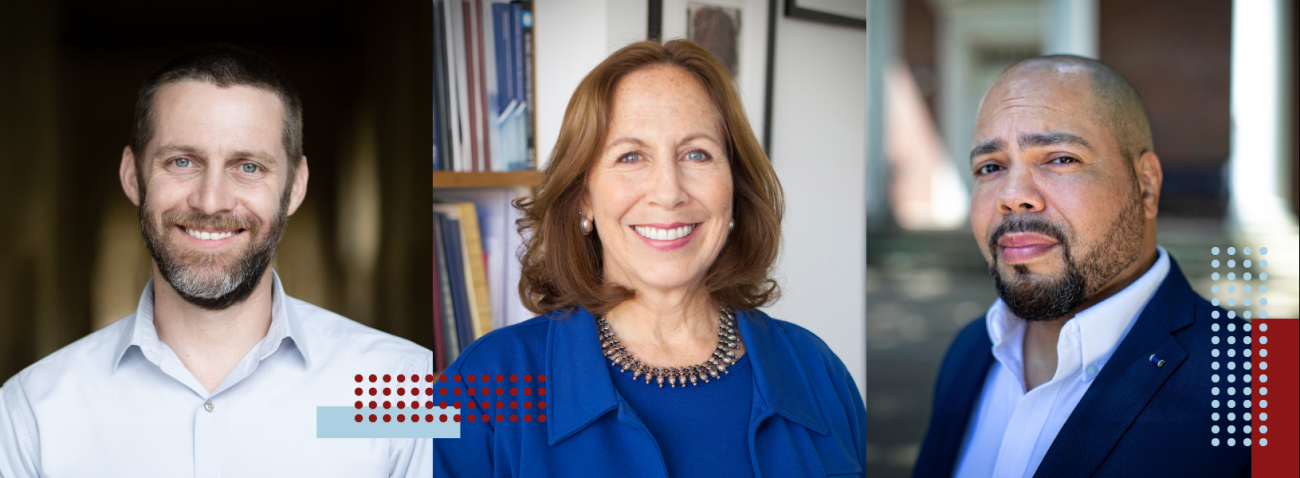
This year, three alumni will be presented with the award at a ceremony on Oct. 16, during Reunion Homecoming Weekend:
- Suzanne Grant Lewis, PhD ’88, independent consultant and former director of the UNESCO International Institute for Education Planning
- Mike Taubman, MA ’05, teacher, program director, and AI innovation lead at Uncommon Schools
- Julian Vasquez Heilig, PhD ’06, professor of educational leadership, research, and technology at Western Michigan University
Since it was established in 2015, the Alumni Excellence in Education Award has recognized 41 GSE graduates whose research, teaching, leadership, and entrepreneurship has advanced education locally, nationally, and internationally.
An accomplished leader with global impact
Suzanne Grant Lewis, who earned her doctorate in international development education from the GSE in 1988, is an international education leader who has worked for more than three decades to improve educational opportunities across the developing world.
Her career spans roles in academia, philanthropy, and global governance. Currently an independent consultant, she serves as a judge for the Yidan Prize Panel for Education Development and chair of the board of directors for the World Computer Exchange. She has worked as a planning and policy advisor to the ministries of education in post-Apartheid Namibia and in Malawi. She spent a decade at the Harvard Graduate School of Education, where she co-designed and directed the master’s program in International Education Policy.
She also served as executive director of the Partnership for Higher Education in Africa, coordinating $440 million in foundation support for African universities, and spent nine years at UNESCO’s International Institute for Educational Planning, where she became the organization’s first female director. Most recently, she served as chair of education science and policy at Education.org, a foundation working to build evidence syntheses for education policymakers.
Grant Lewis is “an imaginative and energetic educator whose broad reach and cumulative accomplishments extend her influence far beyond the settings in which she has worked,” said Joel Samoff, a former adjunct professor at Stanford and her doctoral dissertation supervisor, who nominated her for the award. “The ripples of her work have hit many shores and will continue to shape educational systems well beyond [her] lifetime.”
A groundbreaking educator and innovator
Mike Taubman, who earned his master’s degree from the Stanford Teacher Education Program in 2005, is a high school teacher and educational leader at North Star Academy Washington Park High School in Newark, N.J.
A veteran educator who has dedicated over two decades to the same school community, Taubman began his career as a founding middle school English teacher before serving as English department chair at North Star, part of the nonprofit public charter school network Uncommon Schools.
In 2015, following a semester sabbatical studying deeper learning models, he helped found “High School 2.0,” a project-based learning model that has since expanded across Uncommon Schools to serve more than 3,500 students annually. More recently, Taubman developed “The Summit,” a groundbreaking program for high school seniors focused on purpose exploration and career-connected learning, as well as an acclaimed AI literacy curriculum.
As a fellow with Stanford Digital Education from 2022 to 2026, he worked to deliver hybrid, credit-bearing courses to Title I high school students nationwide. His work has been featured in major media outlets as well as leading education texts and scholarly publications about education research.
“Unlike most educational entrepreneurs, Mike has also stayed in the trenches,” said Michael Mann, head of school at North Star, who nominated him for the award. “He works directly with [his students] and is constantly innovating his practice to make their lives more interesting and to make them better prepared for the future.”
A public scholar and transformative leader
Vasquez Heilig, who earned his doctorate from Stanford GSE in 2006 in educational administration and policy analysis, is a nationally recognized scholar and higher education leader whose work has shaped policy debates about educational equity, school governance, and democratic education for more than two decades.
Currently a professor of educational leadership, research, and technology at Western Michigan University, Vasquez Heilig previously served as the university’s provost and vice president for academic affairs, dean of the College of Education at the University of Kentucky, director of the doctoral program in educational leadership at California State University, Sacramento, and a faculty member at the University of Texas at Austin. During his administrative leadership, the institutions he served achieved substantial gains in enrollment, student success, faculty diversity, research productivity, and philanthropy.
The author of nearly 80 scholarly publications, Vasquez Heilig examines how education policies shape opportunity and inequality, with particular attention to school accountability, finance, segregation, school choice, and democratic governance. He has brought research into public deliberation through legislative and congressional testimony, civil rights advocacy, national media appearances, and his blog, Cloaking Inequity.
“Julian has consistently advanced educational equity while strengthening the institutions he serves,” said Linda Darling-Hammond, professor emerita at Stanford GSE and his former doctoral advisor, who nominated him for the award. “His career reflects the ideals that Stanford GSE seeks to cultivate in its graduates. He exemplifies sustained excellence, transformative leadership, and an enduring commitment to democratic ideals in education.”
Awards ceremony
The award recipients are selected by a panel that includes GSE alumni, faculty, and the dean. Awardees receive an honorarium made possible through the generosity and vision of Angela, ’93, and David Filo, MS ’90, and the Yellow Chair Foundation.
Learn more about and register for this year’s award reception on Oct. 16 and other Reunion Homecoming Weekend events.