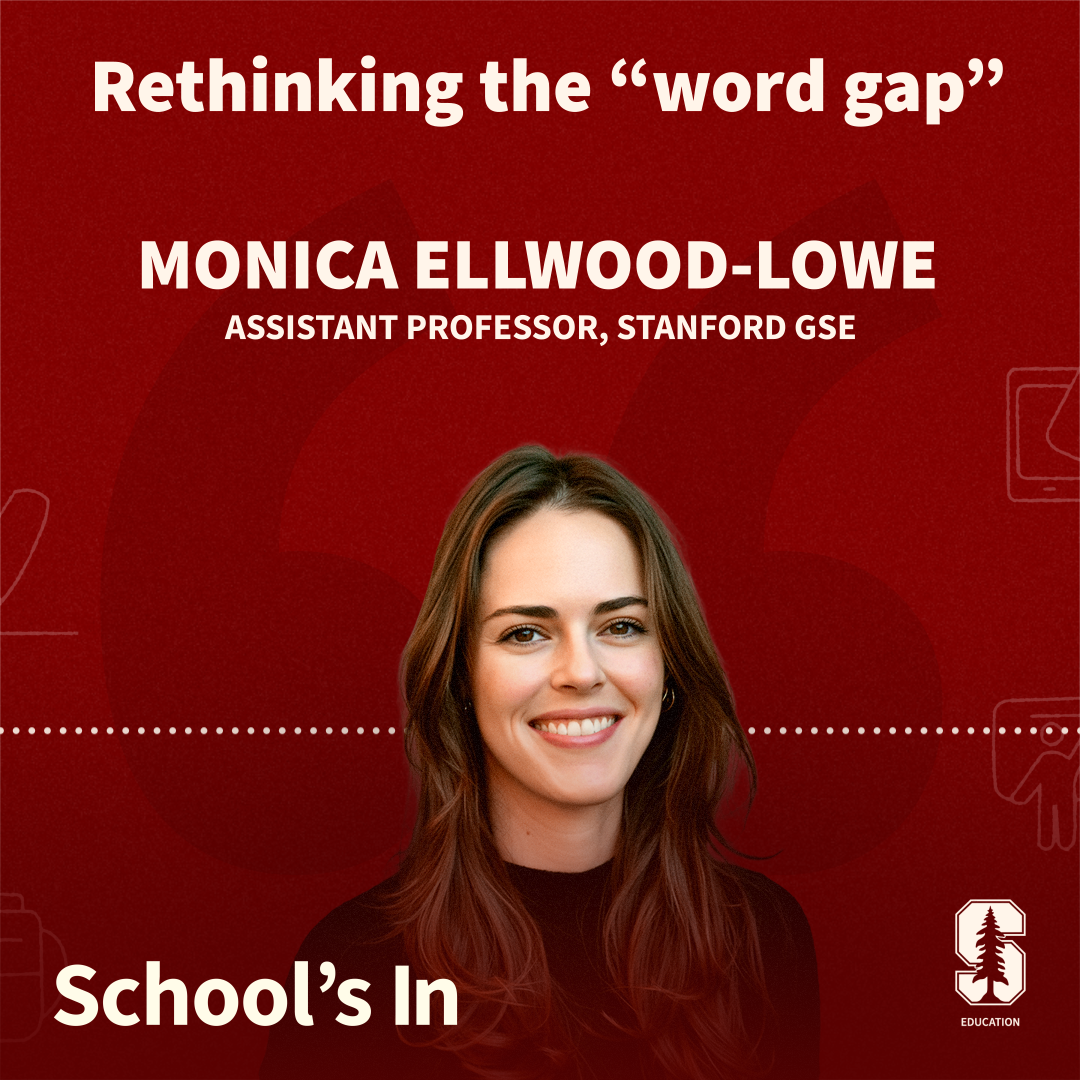
Rethinking the "word gap": What parents really need
For decades, research on children’s learning has focused on the so-called word gap between kids whose caregivers have more education and resources compared with kids whose caregivers have less.
The assumption all along has been that some parents just aren’t doing it right, and that, if parents with fewer resources could be trained to talk to their children more, their children would learn more words and do better in school.
But what if that assumption was wrong? According to research from Stanford Graduate School of Education Assistant Professor Monica Ellwood-Lowe, it is.
Ellwood-Lowe studies how parents’ communication with their children changes depending on their financial situation at the time. Her research has shown that parents talk to their children less immediately after being asked to think about a time when money was tight, toward the end of the month when families typically experience more financial burdens, and in the weeks preceding relief checks provided by the government during the COVID-19 shutdowns.
“In other words, maybe parents don’t need to be trained to talk more to their kids,” Ellwood-Lowe said in a conversation with School’s In co-hosts GSE Dean Dan Schwartz and Senior Lecturer Denise Pope. “Maybe they simply need resources; maybe their lives need to be a little bit easier.”
Ellwood-Lowe says attention seems to be the important variable in child-directed speech.
“If you’re worried about when the next paycheck is going to come in . . . you’re kind of doing math in your head,” she said. “There’s more and more evidence that really what is happening when people don’t have enough resources is an attentional pull.”
Ellwood-Lowe said that children will still learn and acquire language even if speech is not directed at them regularly or by their parents. “Kids are very flexible and very adaptable,” she said. “They can learn from the input that they’re getting.”
Monica Ellwood-Lowe (00:00):
Maybe parents don't need to be trained to talk more to their kids. Maybe they simply need resources.
Denise Pope (00:11):
Welcome to School's In, your go-to podcast for cutting edge insights in learning. From early education to lifelong development, we dive into trends, innovations, and challenges facing learners of all ages. I'm Denise Pope, senior lecturer at Stanford's Graduate School of Education and co-founder of Challenge Success.
Dan Schwartz (00:35):
And I'm Dan Schwartz. I'm the dean of the Graduate School of Education and the faculty director of the Stanford Accelerator for Learning.
Denise Pope (00:44):
Together, we bring you expert perspectives and conversations to help you stay curious, inspired, and informed. Hi, Dan.
Dan Schwartz (00:55):
Well hello Denise, my very verbal friend.
Denise Pope (00:58):
Oh, (laughs) well, it's interesting that you are calling me verbal, because we are doing a show about words and how many words people know.
Dan Schwartz (01:06):
What a coincidence. (laughs)
Denise Pope (01:07):
What a coincidence. It's like you knew. And I have a question for you. It's gonna sound a little bit funky, but I know you know the book Lessons in Chemistry. Listeners, if you haven't read this book, it's great. And there was a character in this book that I thought was... It was so interesting what she did. She would count how many words her dog understood and I thought, "Oh, Dan Schwartz has a dog, loves his dog. I bet he knows exactly how many words his dog knows. So Dan, how many?
Dan Schwartz (01:36):
Uh, you know, it's, it's the category of words that she's knows that's special, like ennui-
Denise Pope (01:41):
(laughs)
Dan Schwartz (01:44):
... angst, you know, determinism.
Denise Pope (01:45):
Okay, no. No.
Dan Schwartz (01:46):
No, okay.
Denise Pope (01:47):
But for real, for real-
Dan Schwartz (01:47):
It's-
Denise Pope (01:47):
... like, how many words you think?
Dan Schwartz (01:49):
I- it's tough to say. So oftentimes, she responds to the word correctly and sometimes she chooses not to. And I don't know if she doesn't understand the command or she's just being stubborn. The other thing is, you know, when you talk to dogs, it's main commands. And most of, uh, the time when I'm saying something to her, it's in a context where she can use the context to figure out, as long as I give the cue of talking to my really high voice.
Denise Pope (02:14):
Like what?
Dan Schwartz (02:15):
You know, like if I say, "Fetch. Fetch."
Denise Pope (02:16):
(laughs)
Dan Schwartz (02:17):
You know, then she knows, oh, because she sees the ball and it, it all makes sense to her.
Denise Pope (02:22):
But if you say, "Fetch. Fetch."
Dan Schwartz (02:24):
She, she just, she doesn't know what's going on. She ignores me.
Denise Pope (02:26):
(laughs) Well, I'm glad that we have an expert on human vocabulary here.
Dan Schwartz (02:32):
We're very lucky to have, uh, Monica Ellwood-Lowe, uh, professor at the Graduate School of Education. And her specialty is developmental psychology, but particularly looking at the effective context on sort of children's exposure to language. And it's quite interesting, but I do know there's sort of been a kerfuffle around this, around the word gap. So maybe if you could just give a little history, Monica, and thank you for coming.
Denise Pope (02:57):
Yes, welcome. Welcome.
Monica Ellwood-Lowe (02:58):
Thank you so much for having me. Super excited to be here. Yeah. So the word gap is this idea that children who come from lower socioeconomic status homes or homes where parents are making less money or have, or less educated know fewer words than children whose families have more resources. And this is an idea that was really popularized by Hart Risley in 1990s, but it was actually studied long before that this idea that kids in poverty or in low resource contexts know fewer words has been studied since the 1950s. So a lot of this work is really looking at how parents are talking to their kids and what the role of parents is in this word gap.
Dan Schwartz (03:48):
And the theory is that, uh, there's less words in the environment or the theory is that the parents spend less time training the kids for the SAT. Like, what, what is the theory behind this?
Monica Ellwood-Lowe (03:59):
(laughs) Maybe both.
Dan Schwartz (04:02):
(laughs)
Monica Ellwood-Lowe (04:02):
The idea I that parents who have more resources and are more highly educated are talking to their kids more.
Dan Schwartz (04:09):
Mm-hmm.
Monica Ellwood-Lowe (04:10):
And so they're just doing more where they're kind of directly engaging in what we call child directed speech, very similar to how we talk to our pets actually. Exaggerated speech, sing-songy, and that allows kids to learn more words.
Denise Pope (04:26):
Can I ask? Is it the tone? 'Cause Dan said something, like, a high... I, I don't know.
Dan Schwartz (04:30):
No. When I talk to my dog, it's things like, "Uh, Kyla, would you, would you like to have a glass of wine with me at the moment?" It's very different.
Denise Pope (04:39):
(laughs)
Monica Ellwood-Lowe (04:39):
(laughs)
Dan Schwartz (04:39):
No, it's not, it's not-
Denise Pope (04:39):
No, but the tone-
Dan Schwartz (04:39):
... it's, it's mommy speech, right? Isn't that the name for it, Monica?
Monica Ellwood-Lowe (04:41):
Motherese.
Dan Schwartz (04:43):
Motherese, there we go. Yeah. Yeah.
Monica Ellwood-Lowe (04:44):
Yeah.
Denise Pope (04:45):
Tell us, Monica, what, where your studies come in. And this has been studied for a while now. Where do your studies come in?
Monica Ellwood-Lowe (04:51):
Yeah. So the idea here is that when children enter school, kids from lower socioeconomic status backgrounds don't know as many words. And that, for that reason, they can't perform well in school and they're just kind of set up to fail from the start. There are a lot of issues with this idea and a lot of issues with the kind of word gap studies, but one of the main issues is that it kind of frames child-directed speech as a choice parents are making based on their parenting knowledge or their level of education. And the idea is parents who know more about what it means to be a good parent are talking to their kids more and therefore those kids are learning more words and set up to succeed in school.
Dan Schwartz (05:42):
I can imagine why there was a lot of unhappiness about this, this kind of claim.
Denise Pope (05:46):
Yeah, controversial.
Dan Schwartz (05:48):
It's the good parent part, right? This is normative behavior that parents should do, and parents who don't do that are, are, are failing their children. Yeah, no, that, those are fighting words.
Monica Ellwood-Lowe (06:00):
Exactly. And there have been a lot of interventions that have popped up to try to train parents to talk more to their kids, so it's even taken beyond "this is good and bad parenting" to every parent needs to learn how to do a lot of this.
Denise Pope (06:13):
And you don't agree. (laughs)
Monica Ellwood-Lowe (06:18):
(laughs) There are a lot of reasons to not agree. So my work has really been focused on trying to understand structural causes associated with why parents might be talking more or less. So if you're a parent and you are in the United States, where there's a really heavy emphasis on engaging with kids a lot but you're super strapped for resources and you're trying to figure out how to budget for groceries before your next paycheck comes in, you might not be as engaged with your child verbally as a parent who is just not so worried about finances. Those things are taken care of and that's not part of their day-to-day thought process.
(07:03):
We were interested in whether the experience of structural inequity itself is actually shaping the way parents are interacting with their kids. In other words, maybe parents don't need to be trained to talk more to their kids. Maybe they simply need resources. Maybe their lives need to be a little bit easier.
Dan Schwartz (07:25):
Give me an everyday example of where stress might make me talk less, just a, a concrete example I can hang on to.
Monica Ellwood-Lowe (07:33):
I will say I don't know that what we're picking up on here is stress. I think it might be attention, right? So maybe if you're worried about when the next paycheck is gonna come in, worried about how you're gonna make ends meet, maybe that's not experienced so much as like, "Ah, I feel so stressed." But instead, it's experienced as this attentional pull. So you're kind of doing math in your head, you're kind of thinking about, "Okay, if I get these groceries and I cook these meals and, and then the paycheck comes in this day..." And I think there's more and more evidence that really what is happening when, when people don't have enough resources and it is an attentional pull. So they might not have that, like, affective experience of something res but rather attention.
Dan Schwartz (08:23):
Oh, that's interesting.
Denise Pope (08:25):
Super helpful.
Dan Schwartz (08:26):
What's your evidence for that?
Monica Ellwood-Lowe (08:28):
Great question. So a lot of the research looking at the word gap has done it correlationally. So they've taken parents who have a lot of resources, looked at how much they talk to their kids, taken parents who don't have a lot of resources, looked at how much they talk to their kids, and said, "Look, there's a difference between these sets of parents." And we were really interested instead in understanding how the same parent might speak differently when they're experiencing financial strain versus when they're not.
(08:58):
So we did a couple different studies to test this. In one of them, we had parents actually imagine a time that they didn't have enough resources and think about that, and we tested how many words they said to their kids immediately following that kind of processing, financial scarcity processing compared to a parent who was asked to just think about things they didn't last week. So we found that after parents had thought about financial scarcity, they spoke less to their kid.
(09:29):
So this was some preliminary evidence. We think that parents spoke less after kind of thinking about financial scarcity, but still we're doing the thing where we're comparing parents to one another. And so in our next study, we wanted to take an approach where we would look at whether a single parent was talking less when they were experiencing more financial strain compared to when they weren't. And so we made use of this common phenomenon that Americans experience the most financial strain at the end of the month compared to the rest of the month. And if this is true, then we would expect parents to talk less at the end of the month relative to the rest of the month.
(10:12):
So we used these really cool all-day language recordings. They basically, like, sit... They're recording devices that sit on kids', uh, front pockets in kids' shirts, um, and automatically quantify kids', uh, language environments over the course of 16 hours. And parents had taken these audio recordings of their kids' environment repeatedly and the timing just varied randomly over the course of the month. So we were able to look at recordings that were taken at the end of the month compared to recordings that were taken at different times of the month, which varied in sequence. And we found that parents on average were talking less with their children at the end of the month relative to the rest of the month.
Denise Pope (10:59):
Hmm, interesting. Very cool way to study it, too, I have to say. Wow.
Dan Schwartz (11:06):
So, uh, you did another study that I really want you to tell Denise about, where during COVID, you convinced parents to record bath time. So could you just describe that study? It's another piece of evidence in this story.
Monica Ellwood-Lowe (11:20):
So after that, we thought this was evidence that parents are talking less at the end of the month, but are they talking less because they're experiencing financial strain really or is there something else happening at the end of the month? When I would present on these results, people would say, "Well, you know, my work schedule is different at the end of the month than it is the rest of the month. It's not about money for me."
(11:41):
And so we were kind of racking our brains like, "How can we actually study this for parents in real time?" And then the pandemic hit and parents were losing their jobs left and right, parents were getting checks from the government. So there were all of these changes in finances that were happening in really time. And so we realized if we could get language recordings from kids' environments repeatedly over a couple of months, then we would probably capture some of these real financial changes that were happening for families.
(12:15):
So we asked, uh, parents of 18 to 26-month-olds, very young kids, to take an audio recording of their kids' bath time every day for 30 to 60 days, and we got this really rich sample of how much they're talking to their kid every single day. And then we also had information about when they experienced a job loss, when they got a check from the government, and we were able to look at how those kinds of experiences affected how parents were talking to their kids.
(12:47):
So we found a couple different things. The first is that parents' mood on average really didn't seem to affect how much they were talking to their kids. It's not the case that parents are talking more when they feel happy, less when they feel sad. Really, some parents speak more or less relative to their mood, but across the board there's no consistent relationship. We did find, again, that parents were talking less at the end of the month, and then even more directly we found that, for parents who were getting a check from the government during their recording times, they spoke more in the week immediately following the check relative to the week immediately before receiving it. So we're now getting pretty direct evidence that just receiving a chunk of money alters the way parents are talking to their kids immediately after.
Dan Schwartz (13:42):
That's compelling. That's really compelling evidence.
Denise Pope (13:44):
So Monica, I think this is so fascinating and I haven't really thought about this before. Cultures... In different cultures, parents speak different amounts of words to their kids, and yet all kids learn language, you said. So talk to me about the different cultures. Can you give me some examples?
Monica Ellwood-Lowe (14:09):
Yeah. There are some cultures where kids are not seen as conversational partners until they're mobile, until they're walking. And so there was a really cool study that my colleague, Ruthie Fouche, did with children growing up in a rural community in Mexico, in Southern Mexico. Uh, they're Tzeltal-speaking indigenous community. And in this community, it is not customary to speak to young children until they're mobile. And so instead, these infants are carried on their mother's backs all day throughout the day, so they're exposed to lots of speech that their mother is directing to other people, but there's no speech directed to them.
(14:51):
And what Ruthie found is that these kids are still able to learn from the overheard speech in their environment. So even in a culture where child-directed speech is not very common, there are other ways that children can learn language.
Denise Pope (15:07):
Super fascinating, because it, because they're learning it from everyone around.
Monica Ellwood-Lowe (15:11):
Yeah. And I think different cultures have different ways of kind of using language. And so the, the goal when you're becoming a language learner is to use language in a way that fits your culture and kids are very good at doing that.
Dan Schwartz (15:30):
So I'm, I'm a infant and, uh, unlike my dog, I don't sleep when nothing's happening, right? I'm, I'm sorry, just bringing back the dog theme. I'm curious. I'm incredibly active. So if I'm not engaged in a lot of parents' speech but I'm watching my parents, what, what am I learning instead?
Monica Ellwood-Lowe (15:49):
You mean you're not hearing motherese?
Dan Schwartz (15:51):
I- I'm just, I'm not, I'm not in conversation with adults. They may be talking.
Monica Ellwood-Lowe (15:56):
Right.
Dan Schwartz (15:56):
I may not be learning words, but I'm, I'm definitely learning something while that's going on.
Monica Ellwood-Lowe (16:02):
Yeah. Maybe you're developing a better understanding of how people relate to one another. So how does your mom speak to the elders in the community? How does she speak to her peers? Um, maybe you're developing an ability to kind of broadly attend to your environment. These are the kinds of questions that I think we need to be asking more in the field, right? We've been so focused on what kids learn from child-directed speech that we haven't been as focused on what they might be missing or what kids learn when they don't have a lot of child-directed speech. And, you know, you're a kid and your brain doesn't just sit there. It's always doing something. So if you're not being spoken to by an adult in your environment, you're probably focused on something else and learning from that.
Dan Schwartz (16:57):
Boy, so that, that, that seems like a tricky thing to get after empirically. Like, like, how would I measure an infant's situational awareness? You know, they- they've learned to notice things in their situation instead of just focusing on the language.
Monica Ellwood-Lowe (17:10):
That's what we're trying to figure out. (laughs)
Denise Pope (17:12):
(laughs)
Dan Schwartz (17:12):
Yeah.
Denise Pope (17:13):
Monica's gonna come back and tell us once she figures that out.
Monica Ellwood-Lowe (17:16):
Bring me back in 10 years and I'll let you know.
Denise Pope (17:19):
We will. We will. We promise.
Dan Schwartz (17:20):
Something with, like, floating balloons, you know, do they notice the balloons floating over on the side? I don't, I don't know.
Monica Ellwood-Lowe (17:25):
So one of the ways we've looked at this in the field is these what we call selective attention paradigms. And so you can basically sit a kid down and there's one speaker on one side of them telling a story, and then there's another speaker on the other side of them telling a story. And embedded in each of these audio streams and the different speakers are weird noises. So maybe there's like a weird noise on the left and then, 10 seconds later, there's a weird noise on the right. And so if you tell kids they're supposed to be listening to one, you actually have an empirical way of measuring how much they're still attending to the other one by how much their brain responds to those weird noises that happen in each speech stream.
Dan Schwartz (18:13):
That is so clever. That is so cleaver.
Denise Pope (18:15):
Okay. So I'm, I'm a parent and I'm hearing all this and I really wanna do right by my kids. What, what, what would you say to me, Monica?
Monica Ellwood-Lowe (18:24):
I would say kids are very flexible and very adaptable. They can learn from the input that they're getting. So it is true that if you say a lot of words to your kid, your kid will probably come to know a lot of words and that can be helpful for school. At the same time, you don't need to be the one doing that. Kids can learn a lot of new words when they hit school from their teachers. They can learn it from their peers. They can learn it from a babysitter or from an aunt and uncle. There are all sorts of ways that kids can learn new words and it doesn't have to be from you.
(19:02):
The other point about that is that there is no sensitive period for which kids must learn words. By that, I mean you... The amount of words that you know when you're 10 months old is maybe not predictive of how many words you know when you're four years old. And so we can learn new words at any point in our life, even as adults, and there's no kind of period in childhood in which kids must learn all of the words in order to be successful language speakers.
Denise Pope (19:35):
That is so good to hear and also totally true. I personally learn new words all the time. Like, there was a time where I just played Wordle and I didn't know the word. (laughs) I was kind of pissed-
Monica Ellwood-Lowe (19:47):
Exactly.
Denise Pope (19:48):
... at the Wordle game developer for using a word I didn't know, but there you go, I've added to my vocabulary. Could I tell you that word now? No, don't ask me, Dan. But...
Monica Ellwood-Lowe (19:55):
But every time you start a new job, you learn a bunch of new words very quickly. We quickly learn the words relevant in our environments and adults are just as good at doing this as children.
Denise Pope (20:07):
And they don't have to do it in a sing-songy voice or, "Hello, you're so cute. How are you?"
Monica Ellwood-Lowe (20:13):
Exactly. We just pick it up.
Dan Schwartz (20:15):
Denise, I have yet to run across a, a word in Wordle that I didn't know.
Denise Pope (20:19):
Oh, okay.
Dan Schwartz (20:20):
Not competitive about this.
Denise Pope (20:21):
Totally competitive, yes. Hello.
Dan Schwartz (20:23):
Yeah, yeah.
Denise Pope (20:23):
It's rare, I'll give you that. It's rare. So much, so much good stuff learned in this episode. Dan, I'm gonna turn it to you to do a little summation, some lessons learned maybe?
Dan Schwartz (20:33):
Yeah. I, I think the question about how much language do you need and when to acquire it... I don't have good thoughts about that. But the idea that, uh, structural conditions in people's lives really have a strong influence on their interactions with their young children, uh, that's something to pay attention to and figure out how to solve that. You know, like, gee, if we, if we gave the paychecks every week, would that solve it? It's a place we generally don't look for to solve psychological problems or psychological issues like learning, but, uh, I thought those were really compelling studies.
Denise Pope (21:09):
Monica, do you wanna have any last words here?
Monica Ellwood-Lowe (21:11):
I think we just need to understand that parenting often has so much to do with what parents are experiencing in the moment. It's not decontextualized. You aren't the kind of parent that you hope to be, aspire to be. It's culturally ingrained and structurally ingrained.
Denise Pope (21:31):
So important. So important. You're not a good parent, a bad parent. It makes me feel so much better. There are times, obviously, when my kids were little, where I was like, "We don't have time to sing Wheels on the Bus right now. We are literally going out the door." And I, and, you know, there's jus... It's the situation. It's the context. And this idea of bad parent versus good parent and who's better, we have to just get that out of the vocabulary. Parenting is hard enough as it is. This is a huge relief to hear that it is not your fault that there's this word gap that's on you and that your learning can grow and your words can grow over the course of a lifetime. That's a, a beautiful message.
Monica Ellwood-Lowe (22:11):
And your kid is gonna be fine.
Denise Pope (22:13):
Everyone, you heard it from Monica. Your kid is going to be fine. Monica, thank you, thank you for joining this episode of School's In. And all of you, all of our listeners, be sure to subscribe to the show on Spotify, Apple Podcast, or wherever you tune in. I'm Denise Pope.
Dan Schwartz (22:30):
I'm Dan who really knows a lot of words.
Faculty mentioned in this article: Monica Ellwood-Lowe