Raising lifelong readers: Why access and role models matter (re-broadcast)
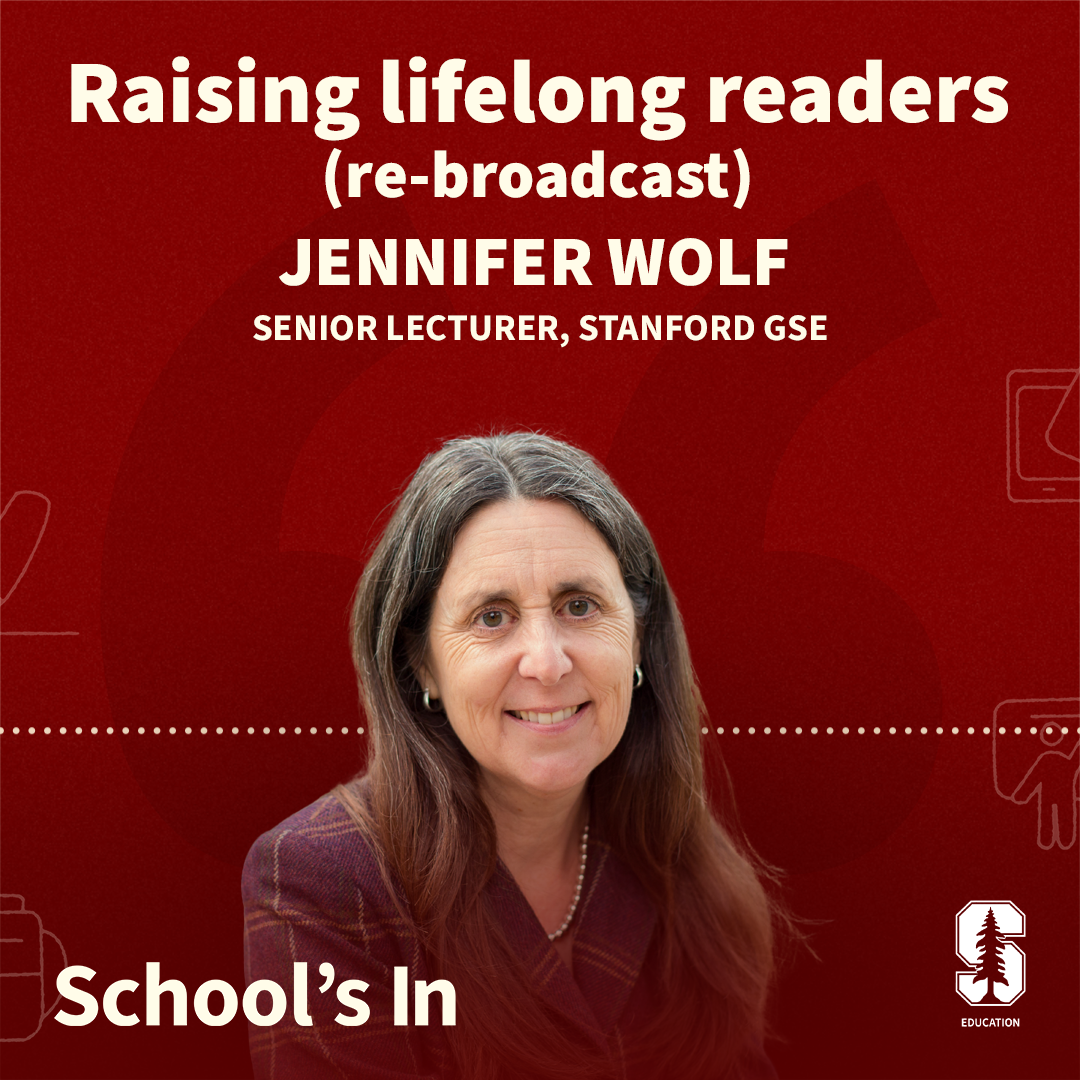
When it comes to reading, kids learn the mechanics and how to interpret what they read—but they don’t necessarily learn to enjoy it, says Jennifer Wolf, a senior lecturer and director of the undergraduate minor program at Stanford Graduate School of Education.
She joined GSE Dean Dan Schwartz and Senior Lecturer Denise Pope on this episode of School's In for a discussion on reading and young adult literature, including banned books, the importance of reading for pleasure, and what makes young adult literature so appealing.
Wolf says parents often ask if reading on a tablet is as good as a paper book. "Light reading is okay; iPad reading is okay; listening to a book on audio is okay; reading comic books; reading the same book over and over again," she said. "Free agency is very important in pleasure reading."
She also says it's important that kids have role models. "One of the single most important factors influencing a young person to grow up to be a person who reads independently and for pleasure is that they see an adult they care about reading for pleasure."
Denise Pope (00:00):
Hi everyone, Denise Pope here. You all know what a big reader I am and how much I love helping others discover the joys of literature. Well, back in 2018, Dan and I had the chance to interview senior lecturer, Jennifer Wolf, on literacy and language. We had a really great conversation about the difference between teaching children how to read and teaching them to enjoy it.
(00:23):
Today we're re-sharing that interview as a touchpoint for you as you cultivate a summer reading habit with the children in your life. You'll hear Jennifer weigh in on the pros and cons of reading from a tablet, the appeal of young adult literature and the most important factor influencing a young person to grow up to be someone who loves to read. Enjoy this episode. It's a good one. We will be back soon.
(00:51):
Welcome to School's In, your go-to podcast for cutting edge insights in learning.
(00:56):
From early education to lifelong development, we dive into trends, innovations, and challenges facing learners of all ages. I'm Denise Pope, Senior Lecturer at Stanford's Graduate School of Education and co-founder of Challenge Success.
Dan Schwartz (01:14):
And I'm Dan Schwartz. I'm the Dean of the Graduate School of Education and the faculty director of the Stanford Accelerator for Learning.
Denise Pope (01:24):
Together we bring you expert perspectives and conversations to help you stay curious, inspired, and informed.
Dan Schwartz (01:33):
Denise English Major Pope. Great to see you.
Denise Pope (01:37):
Yes, I was an English major. Always fun to see you.
Dan Schwartz (01:40):
And today we're talking about literature.
Denise Pope (01:43):
Yes, we are.
Dan Schwartz (01:44):
And we're talking about the best literature on earth.
Denise Pope (01:46):
Which is the young adult literature.
Dan Schwartz (01:48):
It is the best.
Denise Pope (01:48):
Yes.
Dan Schwartz (01:52):
Actually, I think I like the four and five-year-old literature the best.
Denise Pope (01:54):
What's your favorite book?
Dan Schwartz (01:57):
When I was a kid?
Denise Pope (01:57):
Yeah.
Dan Schwartz (01:58):
As a young adult, it had to be The Phantom Tollbooth.
Denise Pope (02:03):
Nice.
Dan Schwartz (02:03):
I love this book. And so I don't know, I'm like 12, 14 maybe, and I get sick, and I asked my mom to sit next to me and read The Phantom Tollbooth, which I think... Yeah, it's very endearing. Although I think it just confused her. It was like, "What are you doing, son? I haven't done this in eight years."
Denise Pope (02:19):
Oh, she thought you were really regressing?
Dan Schwartz (02:21):
I don't know what going on-
Denise Pope (02:22):
Oh, but you wanted that as comfort.
Dan Schwartz (02:25):
I did. It was a great book. I've never seen any movie, any TV show about it. It was completely self-contained.
Denise Pope (02:31):
Don't see the movie.
Dan Schwartz (02:32):
How about you?
Denise Pope (02:34):
You probably haven't heard of this, but this was one of my all time favorites. It's called The Last of the Really Great Whangdoodles. And it is written by a very famous person, but she wrote it under her married name. So the person who wrote it is Julie Edwards. That's her married name. She's really... Do you know who she really is?
Dan Schwartz (02:52):
No.
Denise Pope (02:52):
She is really Julie Andrews.
Dan Schwartz (02:54):
Oh, is that right?
Denise Pope (02:55):
So not only could this woman sing and dance and play Mary Poppins, she also wrote one of my all time favorite books.
Dan Schwartz (03:01):
That's pretty impressive.
Denise Pope (03:02):
Yeah. And I actually can't... I was trying to think of what this book was even about, but it just gives me this warm, fuzzy feeling and I can't even tell you the plot anymore. But just in my head, I created this world based on what she wrote and I have very strong feelings for how it should look. And that's kind of like you. I never want to see the movie because I don't want anyone to ruin my vision of this land and the Whangdoodle.
Dan Schwartz (03:26):
So do you have six books like this or there's just one, there's the one.
Denise Pope (03:34):
No, I have... In fact, this was actually a really hard question for me to answer. I have a ton of favorites, but I was a major reader nerd growing up. All of my siblings, and actually my own kids, we all have books. We're all very into books and- and I'll tell you one funny story. We go on vacation, we're all reading and sometimes we are reading the same books. So the Harry Potter books, when they were coming out, I was reading them out loud to my kids and I would be so into it that I'd put them to bed and then I would read ahead three chapters because I had to know what was going on.
(04:08):
And when we sort of pre-ordered the next book, there were fights over who got it because we all really loved it and I would have to pretend to not know things and they're like, "Mom, you read ahead. We know."
Dan Schwartz (04:20):
They could tell.
Denise Pope (04:21):
"You're such a bad liar." No, this is a big thing and in my house you actually cannot see the movie until you've read the book first. It's sort of a rule that I've just had with my kids growing up and it's really important to me, and they're like, "How come you don't make dad read the book? He hasn't had to read the book." Because it's this really important rule that I make them read the book before they see the movies.
Dan Schwartz (04:46):
Wow, that's really sweet. I think I graduated out of young adult literature too soon.
Denise Pope (04:54):
You went right from there to what?
Dan Schwartz (04:55):
I think in eighth grade I was like reading Anna Karenina, stuff like that.
Denise Pope (04:59):
In eighth grade, you're reading Anna Karenina?
Dan Schwartz (04:59):
Yeah.
Denise Pope (05:01):
Okay. Wow.
Dan Schwartz (05:03):
Yeah. Fantasy's not for me.
Denise Pope (05:05):
So you like the-
Dan Schwartz (05:07):
My son in fact graduated, he started reading business books.
Denise Pope (05:11):
In eighth grade?
Dan Schwartz (05:11):
Yeah. We're just not a fantasy family.
Denise Pope (05:15):
Well, I- we are really lucky because we have one of the leading experts on young adult novels.
Dan Schwartz (05:22):
Yes, we do.
Denise Pope (05:23):
And she actually teaches classes on young adult novels. How fun is that? And we are really lucky to have her here. Her name is Dr. Jennifer Wolf. She's a senior lecturer at the Stanford Graduate School of Education and she directs the undergraduate programs at the Graduate School of Education. She's especially interested in helping young people cultivate a love of reading, a woman after my own heart. Yay.
Dan Schwartz (05:46):
Yes.
Denise Pope (05:47):
And I think English major as well and also former English teacher. So we all have so much in common-
Dan Schwartz (05:53):
I'll just sit and listen.
Denise Pope (05:55):
Yeah, Dan, you're left out. We're in a little love fest here. Welcome-
Dan Schwartz (05:59):
I'm going to be reading my Russian novel on the side.
Denise Pope (06:01):
Welcome, Jennifer. Thank you so much for coming.
Jennifer Wolf (06:03):
Thank you for having me.
Denise Pope (06:06):
So should we ask Jennifer her favorite book? We're springing this on you.
Dan Schwartz (06:09):
Oh boy, that may be unfair.
Denise Pope (06:11):
Is that too hard?
Dan Schwartz (06:14):
I'm looking to see if I get a facial expression on this.
Denise Pope (06:15):
Is that too hard?
Jennifer Wolf (06:16):
It's not too hard. Um, I just translate that question in my mind to what is one of my favorite books.
Denise Pope (06:21):
Okay, good. That's what I do.
Jennifer Wolf (06:22):
I get asked this question a lot. So the first book that my parents ever gave me to have for my own was A Wrinkle in Time, which has just had a sort of resurgence with the movie version that Oprah put together recently. And actually I added it to the reading list for the young adult literature class that I teach this spring because of this kind of resurgence. So it was lovely to revisit it in that way, but the first time I read it, I was in the fifth grade.
Dan Schwartz (06:49):
Okay. Let me ask a really selfish question and then we'll get back to the show. I don't know what grade it was, but there were reading groups, and they didn't sort of name what level you were. They didn't go like gold, silver, and bronze. And one group Read a Wrinkle in Time, one group read Island of the Blue Dolphins, and one group read The Bronze Bow. Which of those was the top most advanced reading group?
Denise Pope (07:16):
Dan is not going to say which one he was in-
Dan Schwartz (07:20):
Not until I hear the answer.
Denise Pope (07:20):
... until you tell him.
Jennifer Wolf (07:21):
Well, Dan will not be surprised to hear that I don't care which group he was in, right? Because I actually, I'm very interested in this idea of how we gauge and brand and title readers. We have a lot of research that... Well, of course we have a lot of research that shows that being able to read is good for you. So that seems a given and we have lots of compelling evidence to show that not being able to read is very bad for you, but we have some even more interesting, at least to me, research about how pleasure reading is good for you.
(07:55):
So this gets back to your idea that you just are reading for work all the time and when you're done with that, you don't have any time left over for pleasure reading. But people who pleasure read, this has a lot of wide-ranging and some unexpected benefits.
(08:09):
So then that raises the question, should we teach kids to like reading? We know we should teach them the mechanics of reading, and we know we should teach them the ability to interpret what they read. So Anna Karenina, or whatever you were reading when you were four.
Dan Schwartz (08:22):
In Russian.
Jennifer Wolf (08:24):
Yeah, uh-huh. But we also perhaps should teach them to love reading and to read when they are not with us. And that's where I think young adult literature comes into play and where my interests really lie. So I don't care what group you are in, I would say A Wrinkle in Time probably has the highest lexile measurement, if that makes you feel better.
Dan Schwartz (08:53):
No, it makes me feel worse-
Denise Pope (08:54):
Because you know where he was. Come on. You were not Island with the Dolphins either, were you?
Dan Schwartz (08:58):
I wasn't.
Denise Pope (09:00):
I know. See, I could have guessed that.
Dan Schwartz (09:01):
Pin wriggling against the wall.
Denise Pope (09:05):
See, I will say this, what we do know about homework in elementary school is that it doesn't really correlate with academic achievement, but you know what does?
Jennifer Wolf (09:16):
Reading.
Denise Pope (09:17):
Reading for pleasure. Not forced reading, not like, "Here, you have to be in this reading group, Dan Schwartz," but reading for pleasure, you choose. That actually correlates with academic achievement in elementary school.
Dan Schwartz (09:27):
Why do you think?
Denise Pope (09:29):
Let's ask the expert.
Jennifer Wolf (09:31):
There are a lot of different theories on this, but the ability to know what you like and then select and show advocacy over what you like and then read it seems to have some broad reaching implications. And there's an interesting and challenging twist to this for those of us who are also English teachers. Krashen's done a lot of work on this out of USC, which is to establish a strong pleasure, independent reading presence, one of the most important things that you should not do is provide any incentive.
(10:05):
So that means no counting pages, no counting books, no putting your name up on the board with a star, saying I'm a super reader, no grading, no testing.
(10:17):
So if we want to teach pleasure reading, how do we do that in a classroom setting or outside of a classroom setting? I just think it's a very exciting challenge.
Dan Schwartz (10:25):
And that is so opposite to the way I studied for the SAT.
Jennifer Wolf (10:27):
I bet.
Dan Schwartz (10:30):
Where it was just a complete ranking points, where you're now reading the red level and maybe that explains why I go watch expensive movies.
Jennifer Wolf (10:39):
Can I tell a story about my daughter? Taking the SAT, she went in early in the morning and the final component that she took was the verbal, and she came out and I said, "How was it?" She said, "It was fine. I fell asleep." Oh, then I was like, "Well, this does not bode well for the scores." Got the score back, 99th percentile. That test does not test your ability to read. It tests your ability to take a test.
Dan Schwartz (11:10):
Or stay awake.
Jennifer Wolf (11:11):
It tests your ability... She said, "You know what? I didn't even read the passages. I just went straight to the answers and made my choices from there."
Denise Pope (11:17):
She's a really good guesser. Can we just specify just real quick, young adult, what's the time period that we call that?
Jennifer Wolf (11:24):
There's a lot of debate, but why don't we go with American Library Association's definition, 12 to 18.
Denise Pope (11:30):
12 to 18 is young adult. Okay.
Jennifer Wolf (11:32):
But as soon as you put any kind of parameters on that, then that just invites everyone to enjoy the argument about what really is a YA book or reader.
Denise Pope (11:41):
So, I'm a parent, I want my kid to love reading. You've convinced me that it does wonders for them and my kid says, "I don't want to do that. I want to read comic books." You okay with that?
Jennifer Wolf (11:52):
Absolutely. Light reading is okay. iPad reading is okay. Listening to a book on audio is okay, reading comic books, reading the same book over and over again.
(12:05):
Free agency is very important in pleasure reading.
Denise Pope (12:08):
Even if I think as a mom, this book is so easy and so stupid, are they really going to get the same benefits out of it as if they read a more challenging book.
Jennifer Wolf (12:16):
But remember, one of the main benefits we want them to get out of it is to experience pleasure in reading as an independent reader. So if they're getting that pleasure out of reading something over and over that's really important to them, regardless of how the parent feels about it and maybe even because of how the parent feels about it, then yeah, absolutely.
Denise Pope (12:36):
Okay.
Dan Schwartz (12:37):
So there was a big transition in my life. I sort of remember this. There was a period where I would go into the library and I'd see all the books and I'd be really excited, and I'd be choosing between them which to read. And then somewhere in my life I go into a library and it makes me nervous because there's all these books I will never read and I won't know them.
Denise Pope (12:57):
Wow.
Dan Schwartz (12:57):
You don't experience that? You don't walk into a-
Denise Pope (13:00):
No, but I can say this, in the Challenge Success Research we ask what you do in your free time and we have reading for pleasure as one of the choices, and we start this survey with sixth graders and we do it all the way up to 12th graders. And in sixth grade reading for pleasure is right there with all the other stuff, playing soccer and talking with friends and all that. 7th, 8th, 9th, 10th, 11th, 12th, straight down, the line is straight down. So you're probably not alone in kind of that drop off of the excitement and-
Dan Schwartz (13:33):
Is it because it's being displaced by other forms of reading or I'm just allowed to do more stuff?
Denise Pope (13:38):
Well, a lot of these kids will say they just don't have time, right? Kind of like you said, "I have to read for work all the time," and they're reading for school all the time, but I don't know.
Jennifer Wolf (13:48):
Well, and there are several different demographics of readers who have different reasons for their reading dropping off. Interestingly, one of the things that research has been consistent across in showing us is that one of the single most important factors in influencing a young person to grow up to be a person who reads independently and for pleasure is that they see an adult they care about reading for pleasure.
(14:10):
And another factor that's really important in pleasure reading and independent reading or free reading or sustained silent reading, all these different names that we call it, is that they need to have access. Young readers need to have access to books. And I'm going to say they need to have access to quality books, to contemporary books, to books that they can get their hands or their ears or their eyes on, that are the same books that a lot of other people are reading as well.
(14:36):
So access to literature and access to quality literature is a big part of this equation. So some kids, their reading drops off, some teens their reading drops off because they're oversaturated with assignments and activities and resources, and some kids their reading drops off or never builds up because they don't have access to reading that is going to call to them.
Dan Schwartz (14:56):
So in my neighborhood, there are sort of like mailboxes and people leave books in them, and I've always wondered how much that's used as a way to-
Jennifer Wolf (15:07):
The Little Free Library Movement?
Dan Schwartz (15:09):
Is that what that is?
Jennifer Wolf (15:10):
That's what that's called. So it's a national movement. I'm very interested in it. When I go back again to the class that I get to teach, the young adult literature class to undergraduates, their final assignment is to design an intervention, mostly small scale that supports pleasure reading for young people, and they design really interesting ways of increasing young people's access to reading for pleasure.
(15:34):
So we look at the Little Free Library Movement and we talk about, "So this is a literacy intervention. This is a reading intervention."
Denise Pope (15:41):
Can you explain how it works a little bit?
Jennifer Wolf (15:43):
So you build a tiny little library birdhouse combination structure and you put it somewhere on your property in front, and you put books in it and there's a little sign that says something like, "Take a book, leave a book." So that's it. That's the description. So you can imagine that it's hard to measure the effects of this intervention.
(16:05):
And it seems that in a lot of cases, what people put in their little free library is books that are really old or they don't care about anymore. So that might have some un-incentivizing effect. But here's the part that I wanted to get to. This year after reading my students' interventions, I was so inspired, I wheeled this table that's down the hall from our offices, Denise, to outside my office and I took 15 really new great YA books from my office that I didn't need anymore, and I put them on the table with a sign that said, "1. Take one, 2. Enjoy it, 3. Pass it on."
(16:40):
And I put little bookmarks in each one that said something about them. I've never had so much fun in my office. Guadalupe Valdez came by and took a book. The guy who empties the recycling bin came by and took a book, undergraduates, graduate students, international visitors. There are interesting ways to disseminate and increase access to literature.
Dan Schwartz (17:02):
So do you still read young adult literacy, Denise?
Denise Pope (17:06):
I do.
Dan Schwartz (17:06):
I do. Even not involving your kids.
Denise Pope (17:08):
I do. And this is the thing, Jennifer has an office next door to me and she is the master. So I'll go in and I'll say, "Okay, seriously, what's hot? What am I not going to be able to put down?" And she'll hand me something, and what's really fun, the fun part for me is that I get to come back and talk to Jennifer about it.
(17:25):
And some of these are like, woo, kind of controversial and kind of unexpected endings. And I was like, "Whoa, wow, I didn't see that coming." So I do. And I also read stuff that my kids read too. When the Hunger Games Trilogy came out, we were fighting over the book so much that I ran to a bookstore and actually got a second copy because I was not willing to wait to see what happened.
Dan Schwartz (17:50):
Wow.
Denise Pope (17:51):
Yeah, I know, it's like that.
Dan Schwartz (18:00):
So Jennifer, is it my imagination or is the highest percentage of banned books come from young adult books?
Jennifer Wolf (18:07):
So depending on who's measuring, the answer is yes, it is not your imagination. We are very- as a citizenry, it seems like we're especially concerned about what our young people are reading and that lands us on a lot of banning or censoring of young adult literature.
Dan Schwartz (18:25):
And it's because kids are old enough now to understand controversial issues and that's why?
Denise Pope (18:31):
I mean, you would think like six to eight-year-old, four to eight-year-olds, they'd be just as concerned, no?
Jennifer Wolf (18:36):
I would imagine speaking as a parent and a teacher that there is just as much concern for the younger kids, but the young adult literature itself has a much higher percentage of controversial topics. And in fact, some people have said that young adult literature sort of exist in order to explore controversial topics and that's what seems to make the folks who speak out against it nervous.
Dan Schwartz (18:56):
Also, who's going to ban Peter and the Purple Crayon?
Denise Pope (18:59):
It's Harold, oh my God. It's Harold.
Dan Schwartz (19:06):
Oh Jesus. Oh God, I'm so embarrassed.
Denise Pope (19:06):
Let's give credit where credit is due.
Dan Schwartz (19:06):
I'm so embarrassed.
Denise Pope (19:07):
No, but I mean there's probably not a whole lot of sex, drugs and rock and roll in books for younger kids, but that is what a lot of the YA stuff is about.
Jennifer Wolf (19:15):
Yes. There are multiple controversial topics, and it raises a host of questions around what can a book do to the reader and in this case, what can a book do to a teen reader? Do teenagers consult books as instruction manuals? If they read a book about taking drugs, does that make them more likely to take drugs?
(19:38):
Does the ending of the book influence how a young person makes decisions going forward? So a lot of developmental tasks sort of merge together with reading tasks, and I think that's what heightens a lot of the concern around who's reading what.
Denise Pope (19:53):
So what's the answer? Because I know that books are pretty influential. Do they cause these behaviors?
Jennifer Wolf (20:02):
So my blanket answer to this is, I love reading and I think reading is really important. And so all of my answers are in the positive about the positives of reading, and that it has "no negatives." But a really important YA author, MT Anderson in an exchange one time said, "Look, if books can do all of these good things, are you also going to argue that they can do nothing bad? Does that make any logical sense?" So I've tucked that in the back of my brain, but young adult literature, I think ultimately is concerned... Ultimately it's concerned with making money as a publishing industry, but it's also concerned with the wellbeing and health of young people. So the books that are written in addition to being of some really terrific literary quality are concerned with the healthy development of young people.
Dan Schwartz (20:57):
So I assume that the young adult literature under-represents certain segments of the population. For example, there's probably less African American young adult literature. Is this true? Is there people working to bring in more voices into young adult literature?
Jennifer Wolf (21:14):
Yes, of course it's true. However, I see young adult literature as being one of the most responsive genres in the United States publication. YA literature really pays attention to what the YA readers want and are doing, and they provide a very quick turnaround compared to other genres in response to that.
(21:35):
I think it goes all the way back to comic books when kids could take their pennies and buy a comic book, and in doing that, not only pay the comic book folks but also could vote with thei r pennies and say, "Here's what we want more of or less of." Same with things like Nancy Drew series that have this quick turnaround.
(21:52):
So to get back to answering your question, I do think that young adult literature has dealt with issues of under-representation for a while, and the Cubberley Lecture guest, Jacqueline Woodson, who came and spoke two years ago, she's done a lot of work in this regard working on the We Need Diverse Books Movement.
(22:13):
And this year, all of the books that were nominated for the Prince Award for our best young adult novel were either about a character of color or written by a character of color, or written by or about a character who's been underrepresented in the past. So there's been a real stepping up in this regard.
Denise Pope (22:33):
Exciting to hear that it's responsive, exciting to hear that it's alive and well because there's been some controversy. I don't know. Should we go there? I just heard about Little House on the Prairie books, and these were books that people loved. I actually personally didn't love them, just saying, but they're now being looked at with a sort of, I don't know, a way to say it, a PC lens. Is this what's happening, Jennifer? What's happening? Tell us.
Jennifer Wolf (23:02):
Well, The Little House on the Prairie Books by Laura Ingalls Wilder, based on her actual life experiences but fictionalized, have been around for a long time. They've been beloved and read widely, and they contain multiple treatments of characters and people and political situations that may have been acceptable at the time that they were written and are largely not considered acceptable, or just plain not acceptable at this period in time. So what do we do with books that have been with us for a long time? And there's a lot of nostalgic love for literature, especially for literature for young people.
(23:43):
So parents and grandparents want kids to read what they read, but when offensive language and stereotypes are contained in those books, what are you supposed to do? Are you supposed to stop reading the books? Are you supposed to think less of the author? Are you supposed to think less of your own reading history?
(24:01):
Or are you supposed to read those books and find a way to talk with young readers about what's contained in them and why we've changed some of our ways of thinking. So that's the controversy as I see it.
Dan Schwartz (24:10):
Are people trying to ban it?
Jennifer Wolf (24:12):
Recently, the American Library Association renamed an award. There was an award given that was named in Laura Ingalls Wilder's name and they've changed the name of that award to not contain her name anymore. So they have not censored her books at all. They haven't asked people to stop reading them, but they have asked people to, when and if they do read the books, to consider these issues.
Dan Schwartz (24:36):
So let me ask you something harder, not socially, but you've read a lot of books. If you read a book, can you tell if it's going to be a winner?
Jennifer Wolf (24:46):
You mean like a mega bestseller? What do you mean by winner?
Dan Schwartz (24:51):
Sufficiently seller.
Denise Pope (24:55):
Not a winner, just like make money for the person who wrote it?
Dan Schwartz (24:58):
No, no. Okay, fine, fine. That it will go down and be a beloved young adult literature book, like Island of the Blue Dolphins.
Jennifer Wolf (25:07):
And how much you love that book.
Dan Schwartz (25:08):
I've never read it. I wasn't in the group.
Denise Pope (25:09):
He wasn't in the group.
Jennifer Wolf (25:11):
I really like Island of the Blue Dolphins, which has a very interesting female of color character at its center and from a very early time in our publishing history. But anyway, we do do an exercise in the young adult literature class where I ask students to predict the next mega bestseller and we look at the bestseller triad of Harry Potter and Twilight and Hunger Games, as Denise was talking about before.
(25:37):
And so far, none of us have correctly predicted the next mega bestseller. And so far there actually has not yet been a book or a series of books that have sold in the way that those three have. But the question you're asking, I think it's a little bit different.
Dan Schwartz (25:50):
It is, it's more like... So one of the great things of being a parent is you get to read to your young child these amazing books. So this is pre young adult literature, and you see them and you go, "This is brilliant." You can sort of see, but you could have never figured out that other people would also find it brilliant.
Jennifer Wolf (26:08):
Oh, I was with you right up till the, but you could never have figured out that other... Yes, I think there, those of us who read and enjoy young adult literature as adults, but also with young readers, when we read a book of that kind of quality and impact and engagement-
Dan Schwartz (26:27):
You can tell.
Jennifer Wolf (26:27):
We know it. Yeah.
Dan Schwartz (26:29):
You can tell.
Jennifer Wolf (26:29):
Yes.
Denise Pope (26:30):
I will say on concrete thing to back that up, which is Walter, the librarian, at Girls Middle School said to me and everybody when he published this book early on, "Hey, there's this new book out. It's about a kid who hides in a cupboard with a scar. You should read it. This is going to be a really big bestseller." And he predicted Harry Potter going through the roof. So librarians and people like Jennifer, I think she's being modest, I mean, they absolutely have the ability to kind of tell and know what's going to hit.
Jennifer Wolf (27:02):
And I think that's part of the purpose of the literary awards that are out there. That's a way that librarians and authors and publishers try to say, "We think these are the books that are destined for this kind of next life." I mean, for the most part, young adult literature has a short shelf life with a lot of rapid turnover, for some of the reasons we were talking about before. But when books win an award or they get that gold foil label on the cover or they hit the mega bestseller status, then they're around for a long time for all of us to enjoy and for the next generations to enjoy.
Denise Pope (27:34):
And we're the better for it. Thank you so much, Jennifer, for joining us. What a fun show, and thank you for listening to this episode of Schools In. Be sure to subscribe to the show on Apple Podcasts, Spotify, or wherever you tune in. I'm Denise Pope.
Dan Schwartz (27:49):
And I am Dan Schwartz.
Faculty mentioned in this article: Jennifer Wolf