How we learn to read (and why some struggle)
Learning to read requires the brain to wire an entirely new systems-level circuit that integrates data from three existing systems—visual, auditory, and semantic—to recognize a word as something with a specific sound and meaning.
That incredibly complex skill is—on the scale of human evolution—relatively new. And, perhaps unsurprisingly, it can be hard for some children to learn.
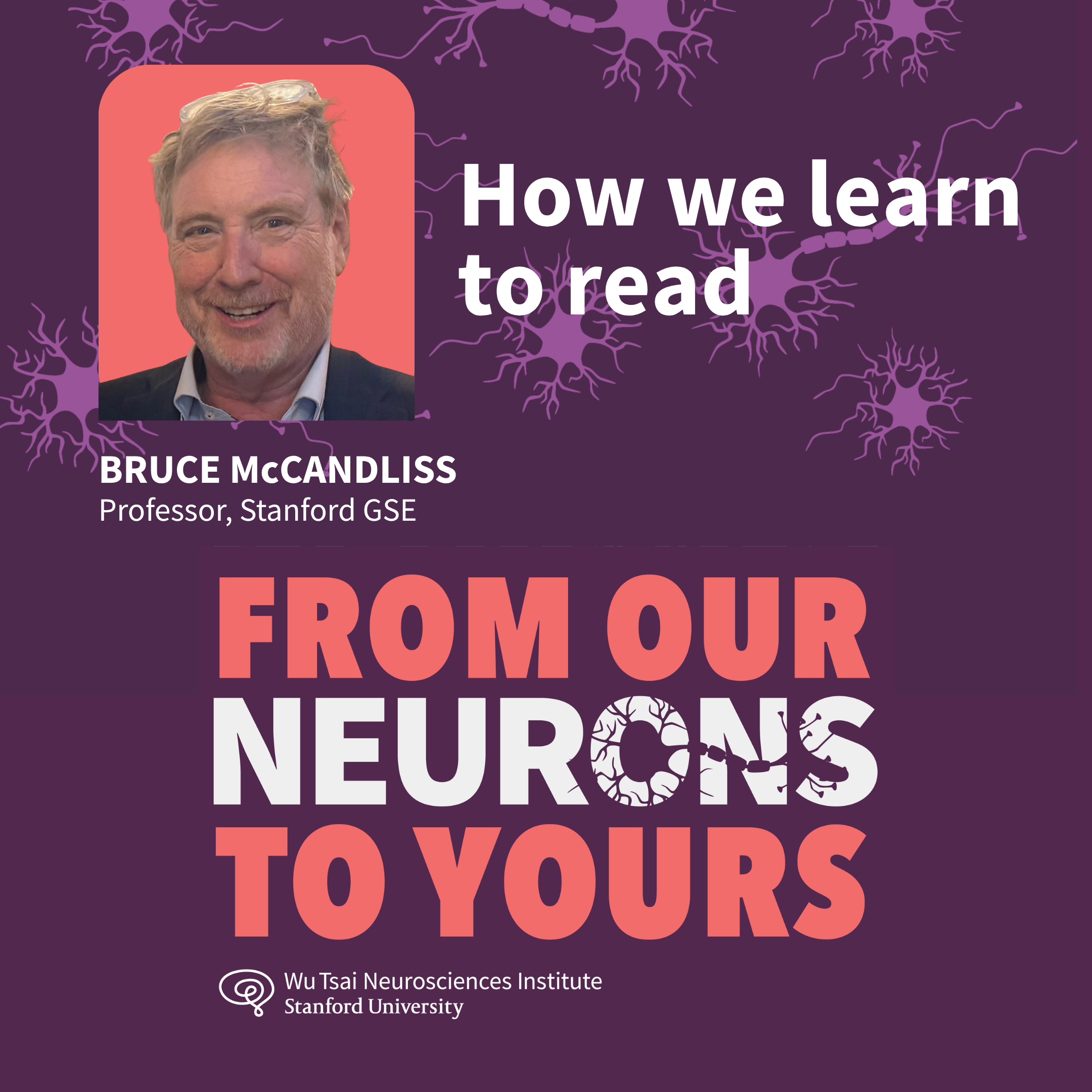
“This whole skill is something that doesn’t really exist in the minds of most humans that are under 4 years of age,” Bruce McCandliss, The Pigott Family Graduate School of Education Professor, told Nicholas Weiler. Weiler, the host of the Wu Tsai Neurosciences Institutes’s podcast From Our Neurons to Yours, spoke with McCandliss last year.
McCandliss and his colleagues study the science of reading. They have found that people who have acquired literacy develop a form of perceptual expertise that allows them to rapidly identify a word’s structure and guess how it would be pronounced, even if they have never seen the word before. Language recognition, and the speed at which it occurs, has huge implications for reading comprehension.
Once that expertise is developed, McCandliss says, reading “happens effortlessly,” and, “the more you develop this perceptual expertise, the easier it is to learn.”
But that’s not the case for everyone. McCandliss said children whose visual or language skills are lagging—who have difficulty, for instance, recognizing rhyming words or how a word changes if one sound is removed—may struggle with reading.
“One of the biggest predictors of persistent challenges in reading, which we think of as this visual skill, [is] individual variation in the language system,” McCandliss says. “That [can] wind up spelling really big challenges for kids when it comes to . . . reorganizing your brain to combine vision and language for this cultural skill that we call fluent reading.”
There are effective interventions. For instance, teaching children how to recognize the structure and sounds of words can have a “profound impact” on learning, especially for children who are behind.
That tracks with other research by McCandliss that shows that the white matter in children’s brains develops differently depending on what school they attend.
“The connection between human neuroscience and human education . . . is a really profound one,” McCandliss says. “We could start changing the way we engage with children as we start to understand how their brains are changing.”
Faculty mentioned in this article: Bruce McCandliss