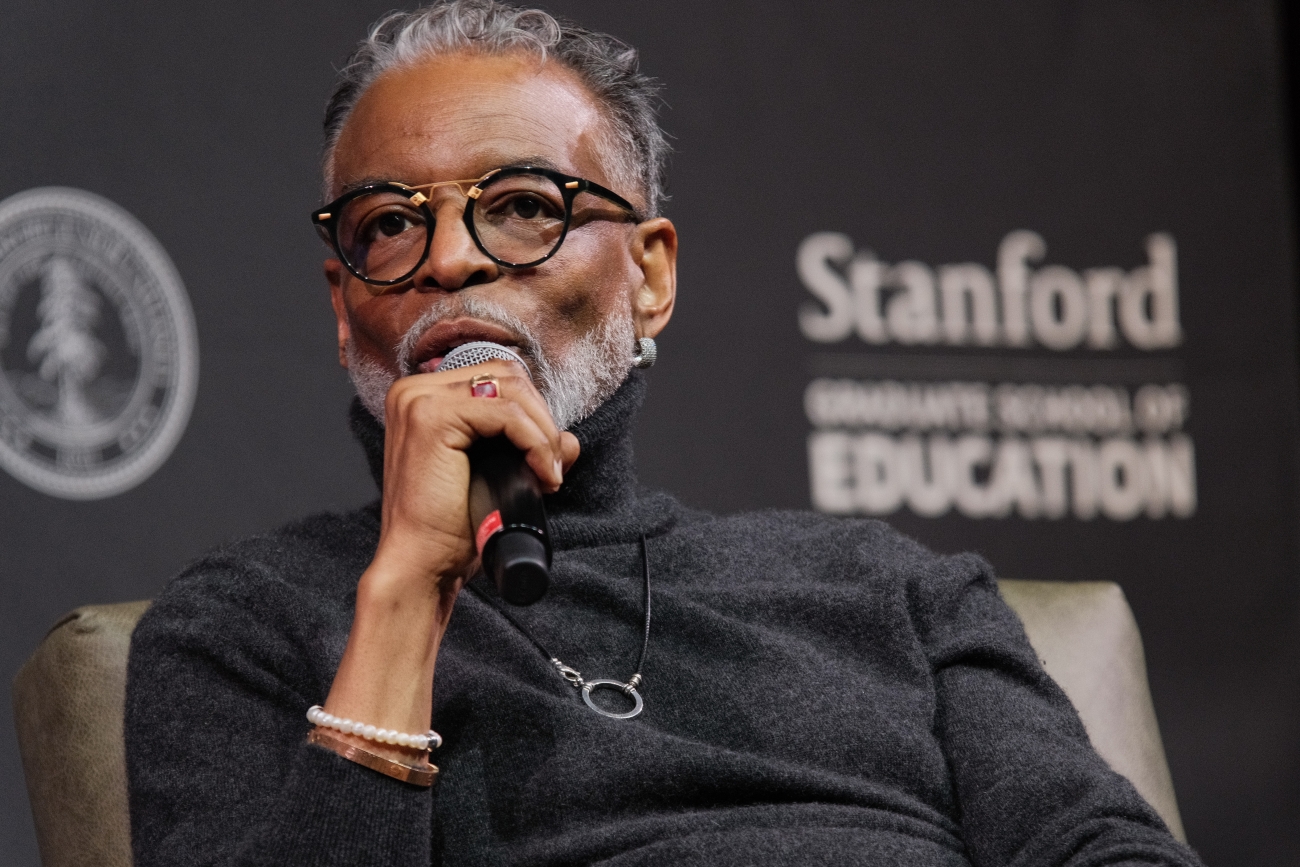
At Stanford event, LeVar Burton says reading unleashes the imagination
He showed millions of people the human cost of American slavery through his portrayal of Kunta Kinte in Roots, the 1977 television miniseries adapted from Alex Haley’s family history book.
A decade later, he expanded television viewers’ imaginations of what could be possible - in technology, in relationships, and in new frontiers – during his role as Geordi La Forge on Star Trek: The Next Generation.
And in between, actor LeVar Burton began inspiring millions of children as the host and executive producer of Reading Rainbow, the PBS show that hooked generations of kids on a love of books while helping teach an invaluable lesson:
“If you’re a reader for life, then you can self-educate,” Burton told a lively, near capacity crowd at Memorial Auditorium on Thursday, May 7, as the speaker at Stanford Graduate School of Education's Cubberly Lecture Series. “You are – by my definition – free. Because no one can imprison your mind. Or your imagination.”
In a conversation with Maisha Winn, the GSE’s Excellence in Learning Professor and faculty director of the Stanford Accelerator for Learning’s Equity in Learning Initiative, Burton wove the strands of his television career and early influences with his thoughts on the current state of literacy, technology’s impact on education, and the importance of unfettered imagination and rich storytelling.
“Having a real fertile connection with your imagination is so important because chief among the tools y’all will need to solve the problems we are leaving to you is your imaginative capacity,” Burton said, aiming his remark at the younger members of the audience
Burton took the stage to loud cheers and applause after a brief introduction from GSE Dean Dan Schwartz,
“He is a trifecta of perfection for the Graduate School of Education. His work is focused on an imaginative future, the role of the past in shaping our now, and the nonstop love of learning and reading that carry us forward,” Schwartz said.
He added that the GSE had already had a “big year,” with the opening of new buildings in the center of Stanford campus. “But alas,” he said, the new spaces “were not big enough for the enthusiasm that we've had for this year's guest of honor.”
Storytelling roots
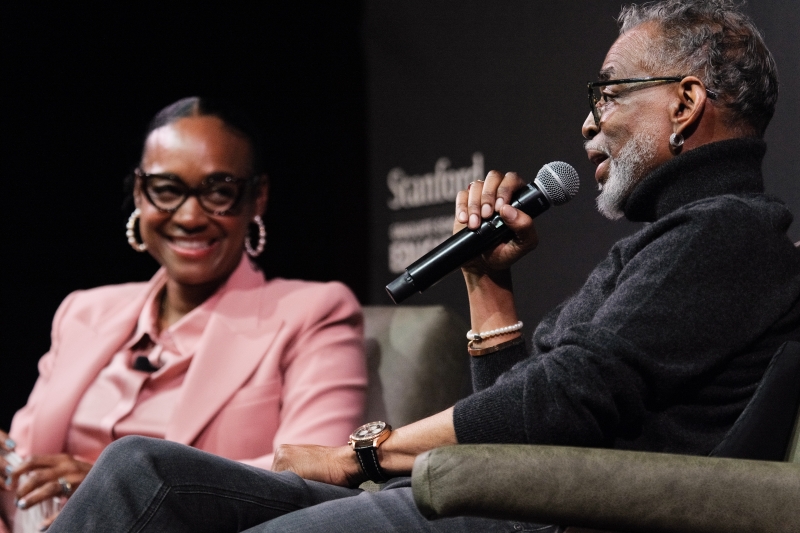
Winn began the conversation by exploring Burton’s family legacy in education. Burton’s mother was an English teacher turned social worker. She worked nights as a cocktail waitress to pay for his college books and instilled in him a deep respect for literacy, reading two or three books at a time. Burton credited his sister, a life skills teacher who was in the audience, with teaching him to read and paving the way for his career success. He also recounted a childhood reading moment with his aunt, who taught him to trust his own knowledge and take risks in reading.
“Parents and teachers ask me all the time, `How do I get my kids to read more?’” Burton said. “Number one, what are your kids passionate about? Because it is our passions that tend to drive our reading appetite.”
“And then I ask them, `How often do your kids see you read?’” he continued. “We have to be aware of what we're doing, not simply what we're saying to our kids in terms of the importance of reading literature.”
Burton described how he used his lead role in Roots to help reframe the story of American slavery to show there was a human – not just an economic – impact of the system. He said the role of Kunta Kinte – and the cultural event that the miniseries came to represent – helped shift a majority narrative around Black Americans that put limits on their capabilities and desires.
“Roots was an opportunity to, through brilliant storytelling, have people open their minds and open their hearts and take in this very important part of who we are as a nation,” he said. “Kunta Kinte and his family put a face on the institution of slavery and that was important for America.”
Imagination and innovation
Perhaps Burton’s strongest message – and sweetest – came while discussing his work with Reading Rainbow, a show launched in 1983 with the intent to help curb the so-called “summer slide” when children’s learning can slip in the months between academic years.
“Butterfly in the sky,” Burton serenaded the crowd with the show’s theme song. “I can go twice as high.”
Then, turning his microphone toward the audience: “Take a look. It’s in a book. A reading rainbow,” crooned the crowd.
Burton said the show’s goal “was to take a child who could read and turn them into a reader for life.”
“Quite honestly, I don’t think that there’s a better technology than words on a printed page simply because it engages our imagination on the level that nothing else does. When I’m reading a book, I’m the director, I’m the costume designer, I’m the prop man. I make all the decisions about what’s going on, what it looks like, and how it flows. That’s power, right?”
He said technology can aid in learning but it must be used intentionally and with care.
“I’ve spent a good part of my career using the technology of the moment in the service of educating children,” he said. “All media is educational. The question is, ‘what are we teaching?’”
Throughout the evening, Burton repeatedly praised teachers – to whooping applause – for drawing out children’s potential.
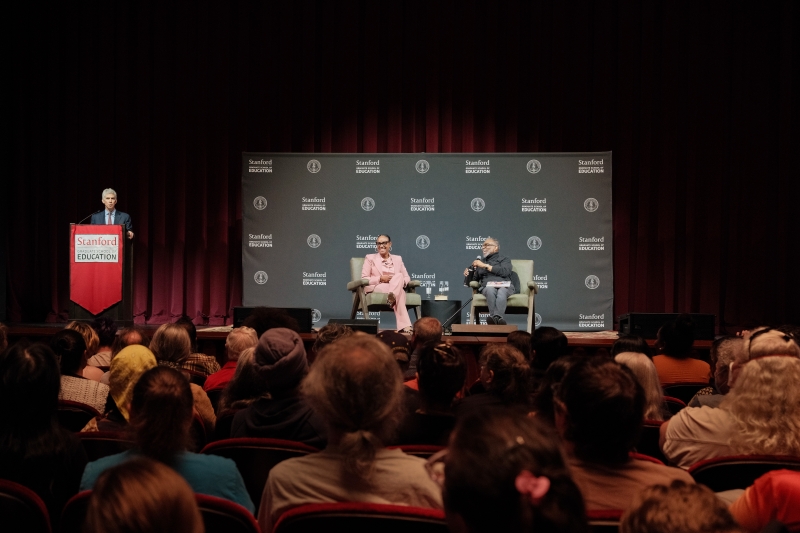
This year’s Cubberley Lecture coincided with national Teacher Appreciation Week. The auditorium included a number of students from the Stanford Teacher Education Program, as well as local librarians, educators, parents, and more.
“Teachers and librarians tend to be my favorite people on the planet because they know what the mission is,” he said.
Humanity and technology
In 1987, while still working on Reading Rainbow, Burton was cast in Star Trek: The Next Generation. He said the show endures because of its positive storytelling: it imagines that humanity survives and creates an egalitarian future where everyone has agency. He also said it showed how imagination leads to discovery - recalling the show’s communicator, which inspired the real life flip phone.
“Human beings are manifesting machines. I just figure that we need to be more conscious about that which we manifest because we do it on unconscious levels as well as conscious. So you might as well do it on purpose and not manifest that which we do not want to realize in our lives,” he said.
During the last quarter of the event, Winn moderated a Q&A with the audience, in which Burton was asked about the current state of the arts (“It’s incumbent upon us to be the artists and be champions of the art’), his authenticity (“I was not willing to surrender who I was for anyone”) and democracy (“We need to get loud. We need to get vocal, right?”)
Provost Jenny Martinez rounded out the program. A self-described Trekkie, she said she appreciated the relationship between Burton’s character Geordi and the android, Data, for illustrating the need for humanity amidst technological progress.
“As we think about education and creativity in the age of AI, it's that marriage, not just of knowledge, but of understanding that comes from our relationships,” she said. “That comes from the aspects of your character … that I think reflect you as a person in your life's journey.”


Faculty mentioned in this article: Maisha Winn , Dan Schwartz