Education’s ethical challenges: Navigating complexity in community
If a student constantly disrupts class and prevents his peers from engaging meaningfully with the lesson, that may not be merely a classroom management problem. It may be an ethical dilemma.
Consider this: The student making the jokes struggles with impulse control; his own learning is governed by an individualized education program (IEP) for students with special needs, and the teacher is legally obligated to accommodate him. The teacher also needs to successfully impart the lessons of the day and to model treating all students with the respect and dignity they deserve. Can she do all of that, at the same time?
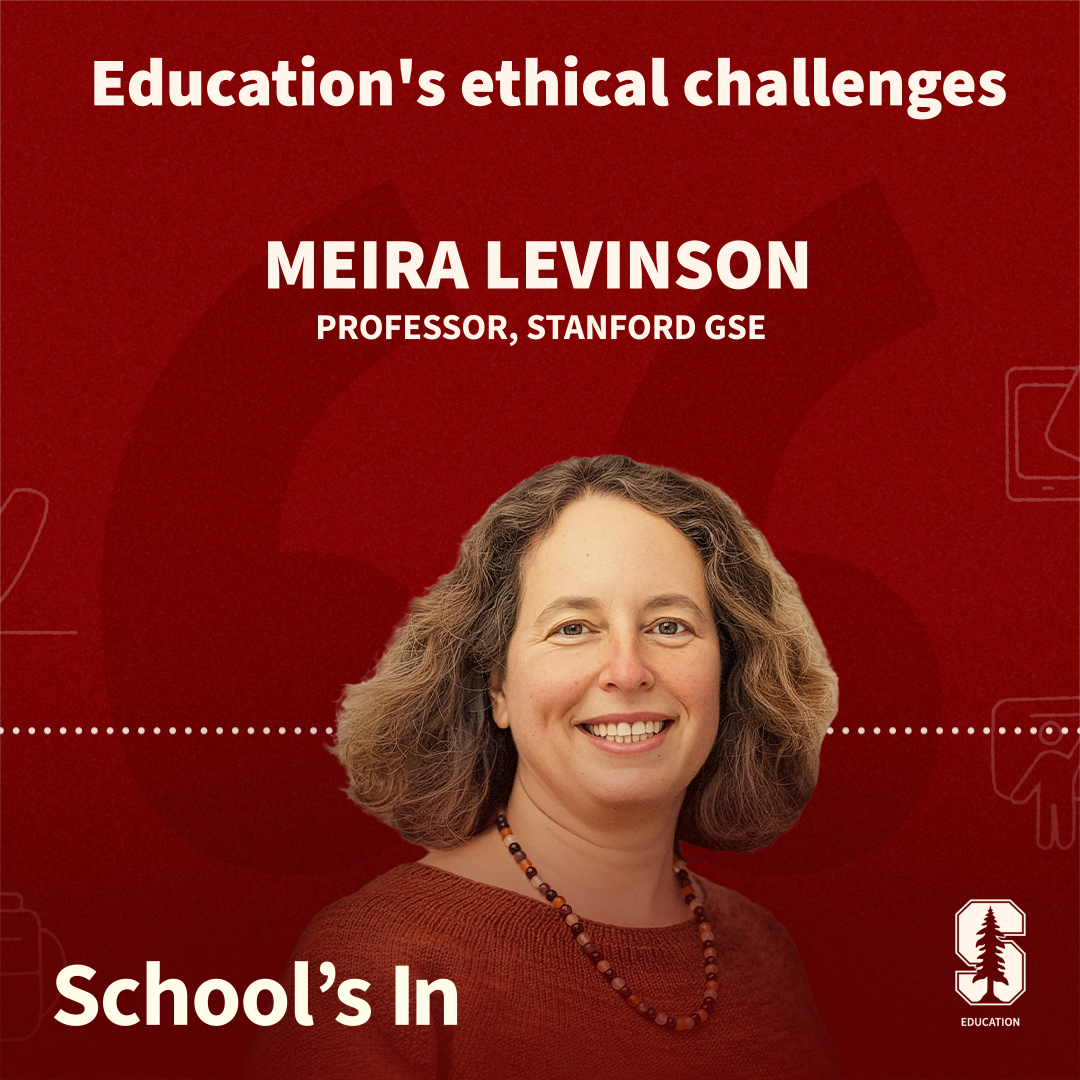
According to Stanford Graduate School of Education (GSE) Professor Meira Levinson, just considering all the conflicting values at play in that hypothetical situation is a step in the right direction, and an example of why she’s working to create a new field called educational ethics. Like equivalent fields in the law or medicine, EdEthics would facilitate hard conversations so that teachers and policymakers are better prepared for the dilemmas they face in their classrooms, schools, and districts.
“Ethical questions are ones in which we are thinking about values,” Levinson says. “One of the really big challenges that we face is that educators and educational leaders and policymakers rarely feel as if they can articulate ethical uncertainty or complexity.”
Levinson joins School’s In cohosts GSE Dean Dan Schwartz and Senior Lecturer Denise Pope to dive in to what counts as an ethical decision, how teachers face value conflicts daily, and why acknowledging those conflicts can lead to more just and humane educational practices.
Levinson said her advice for educators and parents would be to “recognize that others are also wrestling with the ethical dimensions of their work and invite others in to talk together because there is just more power and promise working on these things in community than by yourself.”
You can learn more about Levinson’s work and access resources at justiceinschools.org.
Meira Levinson (00:00):
If we have a field of educational ethics, then we will have people, and ideas, and frameworks that can help in real time when schools, and districts, and institutions, and systems, and structures face novel ethical questions.
Denise Pope (00:21):
Welcome to School's In, your go-to podcast for cutting edge insights in learning. From early education to lifelong development, we dive into trends, innovations, and challenges facing learners of all ages. I'm Denise Pope, senior lecturer at Stanford's Graduate School of Education and co-founder of Challenge Success.
Dan Schwartz (00:44):
And I'm Dan Schwartz. I'm the Dean of the Graduate School of Education and the faculty director of the Stanford Accelerator for Learning.
Denise Pope (00:54):
Together, we bring you expert perspectives and conversations to help you stay curious, inspired, and informed. Hi, Dan.
Dan Schwartz (01:05):
Hello, Dr. Pope. Always nice to be with you.
Denise Pope (01:08):
Nice to be with you again. And I don't know if our listeners know this, but I know that you were a philosophy major in college.
Dan Schwartz (01:18):
I was.
Denise Pope (01:19):
And today's topic is gonna have to do slightly with that. So what, what was your favorite area, or least favorite part of learning philosophy?
Dan Schwartz (01:28):
You mean when I actually went to class? Uh-
Denise Pope (01:31):
Oh. (laughs)
Dan Schwartz (01:31):
... pro- probably-
Denise Pope (01:33):
Yes.
Dan Schwartz (01:33):
I, I like, I like things about the nature of knowledge.
Denise Pope (01:36):
The nature of knowledge. What does that mean?
Dan Schwartz (01:38):
Uh, how do you know? How do you come to know? I kinda like those. Uh, you wanna know my least favorite?
Denise Pope (01:44):
Yeah.
Dan Schwartz (01:45):
Ethics.
Denise Pope (01:45):
Oh, (laughs) Dan.
Dan Schwartz (01:47):
Ethics was really tough. Like, and, and I sort of could never sort out, was it tough because I'm unethical?
Denise Pope (01:55):
(laughs)
Dan Schwartz (01:55):
Or was it tough because it was just really hard and the professor never gave an answer?
Denise Pope (02:00):
Never would say, "You're right," or, "You're wrong."
Dan Schwartz (02:02):
Or say, "Here's how to think about it."
Denise Pope (02:04):
Oh.
Dan Schwartz (02:04):
Just so I, so I don't know, you know, where, where I sit in the spectrum of ethical behavior.
Denise Pope (02:11):
Interesting.
Dan Schwartz (02:11):
I know.
Denise Pope (02:11):
Interesting.
Dan Schwartz (02:13):
Well, fortunately, surprise, we have an expert with us. We have our newest and bestest professor at the Graduate School of Education, Meira Levinson. And Meira wants to start a field called Ed Ethics, like, just like we have bioethics as a field, it's very consequential. And so she's gonna help us understand what ethics is and then how do you start a new field? So welcome, Meira.
Meira Levinson (02:38):
Thank you. I'm really excited to be here with you.
Dan Schwartz (02:41):
Okay. So, uh, I need some help. Denise and I had an argument about how many ethical decisions a teacher makes per day. And our inability to answer that made it clear to me that I'm not quite sure what falls in the purview of ethics. So, what is it, Meira?
Denise Pope (02:58):
Help us. (laughs)
Meira Levinson (03:01):
(laughs) So, hopefully your argument was, say, between dozens and hundreds or something, rather than between single digits.
Dan Schwartz (03:14):
Oh, God, (laughs) I am so in trouble. (laughs)
Denise Pope (03:14):
Dan, Dan-
Meira Levinson (03:14):
(laughs)
Denise Pope (03:14):
I win. I, I just pointed that out. I win.
Meira Levinson (03:15):
(laughs)
Denise Pope (03:15):
But okay, go ahead, go ahead, Meira. (laughs)
Meira Levinson (03:19):
So, you know, ethical questions are ones in which we are thinking about values. What values are we living out? What values are we trying to achieve? What values are we trying to model, uh, for our students, for our colleagues, for our parents, for our administrators? What values have we been told we should be instantiating, right?
(03:44):
So, in w- some ways, I think, you know, everything that we do in education is value laden. There are questions about why are we doing what we're doing? Why are we teaching what we're teaching, demanding of students what we're demanding, who's in our classrooms and who's not, who is in our, you know, both as students and as educators, whose voices matters in determining also the answers to these questions? Like, "What are we teaching, what are the consequences of what we're teaching? What if kids don't get it? What if they don't, you know, if they fail a test?"
(04:17):
W- Like, all of those, right, are value-laden decisions that we're making. So, I think they're all ethical decisions. That doesn't mean that the teacher, him or herself, or themselves, is always the one making the ethical decisions, right? Often, just as with curriculum, and assessment, and all sorts of other things, you know, things are told to teachers about what we need to be doing, what values we're supposed to be instantiating, modeling, et cetera.
(04:45):
But just as we know, there's a huge gap besw- between, say, the prescribed curriculum and what decisions a teacher makes in the moment, right, and, w- you know, what, say, Deborah Ball calls the discretionary spaces of teaching, right? So, "I know I'm supposed to be teaching everybody fractions, but what do I do with this kid who is not understanding the difference between the denominator and the numerator? And, you know, what do, what is, uh, my pedagogical repertoire that I have available to me? And how do I, you know, combine that with my pedagogical content knowledge in order to make the decision in this very moment to help this very kid help to understand fractions?"
(05:25):
I think similarly, we may know, "Oh, as a school or as a district, we are committed to the following values. And I am teaching the material I'm teaching because it upholds the following values. But in this moment, as I have a kid who is disrupting this, or who has gotten really offended by it, or who's desperate to share their ideas, and, like, I know that I'm supposed to be upholding student voice and a sense of empowerment, and I'm also supposed to be upholding academic rigor and, like, getting ourselves (laughs) through the curriculum." Right? In those moments, just as in, like, you know, the discretionary spaces of getting through, you know, thinking about the curricular decisions, we face these ethical decisions. I think educators face these ethical decisions all the time.
Dan Schwartz (06:15):
So, Meira, what would a field of educational ethics be? Are you leading people to become more ethical or you're saying, "These are the animating questions of our time?"
Meira Levinson (06:28):
So, I think that a field of educational ethics in part will help people at every level of education and in every role in education, actually, be able to admit that there are ethical questions and challenges in our work. So I think one of the really big challenges that we face is that educators, and educational leaders, and policymakers rarely feel as if they can articulate ethical uncertainty or complexity. Instead, when we talk openly about ethics, we talk about it in a way that is about assertions of clarity and taking the moral high ground.
(07:15):
I believe that zip code should not be destiny, and therefore, I believe we should have charter schools, should not have charter schools, should have high stakes testing, should not have high stakes testing, you know, should adopt this textbook, or get rid of all textbooks, or whatever it is, right? And if you disagree with me about whatever policy or practice I'm putting forward, then you must not think that zip code should not be destiny. In fact, you must think that zip code should be destiny, right? I am in favor of educational excellence. I am in favor of educational equity, of education for social justice.
(07:48):
Like, there are all these claims that we make that then are designed to stop conversation instead of open up conversation. And we need to be honest, and we will end up having more ethical policies and practices if we can be open about the ethical challenges and disagreements we face. So, one goal of a field of educational ethics will be to open up space for the hard conversations about the hard ethical questions that we face.
(08:22):
A second goal would be, in fact, to offer some guidance because not all ethical questions are hard, but there are some practices and policies that we have in schools, and in districts, and in systems, and in structures that persist and are very widespread, even though they are, I think, unethical. And so a second role for the field would be offering some policy guidance. And I think a third role for the field would be to offer frameworks, and heuristics, and also even mediation or moderation roles at times of decision making, particularly about new challenges.
(09:04):
So, as we think about, say, questions of AI and, you know, new tech in education, as we think back to when COVID hit and suddenly schools were facing a whole bunch of new questions, in both of these realms, actually, uh, thinking back to bioethics, there are more resources because of bioethics to doctors, scientists, public health officials to think about the hard questions surrounding, say, AI in medicine, or AI in public health, or AI in science, and to think about, say, the hard ethical questions surrounding COVID, than there are available right now to those in education and education policy. And if we have a field of educational ethics, then we will have people, and ideas, and frameworks that can help in real time when schools, and districts, and institutions, and systems and structures, face novel ethical questions.
Denise Pope (10:01):
I think that's super exciting. I'm like, "I'm jumping out of my seat with excitement." I hear a lot of times from parents and families, "Why are we getting all into this in school? Why can't we just go back to math, and reading, and writing, and, like, take all of the controversial stuff out of it, right?" And they think that (laughs) ... They think that there's no values associated, and, "Let's just go back to a time when there were no val- when it was just, you know, not value laden."
(10:31):
And education has always been value laden, what to teach, how to teach, who gets what, right? But there's this real misunderstanding on the part of, I think, a lot of people that ethics, just, "Let's just take everything out of it that's controversial and just have school." And you're kind of saying, "Uh, folks, never been possible, never will be possible." So, yay to that.
Dan Schwartz (10:54):
So, Meira, I'm, I'm more of an experiential learner, so is there any chance you could lead us through kind of an ethical scenario and then, uh, Denise can point out all the ways I'm wrong?
Denise Pope (11:07):
(laughs) I do, I do that really well. (laughs)
Meira Levinson (11:10):
(laughs) Yeah, I bet that you do, Denise. (laughs)
Denise Pope (11:11):
(laughs)
Meira Levinson (11:14):
I can do that. (laughs) Um, sure. So, we have a website, justiceinschools.org that has actually about 50 cases online, um, to help educators, students, parents, school leaders, policymakers talk about the hard ethical questions we face. And one of the cases on there is actually like a micro case. So here, I'm just gonna read it to you. While I'm reading it to you, what I want you to think about is what are some of the dilemmas that you think any of the characters in this case are facing, and why are those dilemmas for you? And by dilemma, I'm going to mean, like, just a hard problem where there's not a clear, right answer because there are, say, different values that are, might be in conflict with one another, okay? So here's the case.
(12:08):
Adam is making wisecracks and asking obscure questions while his teacher, Mrs. Wilson, is trying to lecture on the Constitutional Convention. This is preventing the other 26 students in the class from learning the material. Adam has a lot of trouble with impulse control, and in fact, he has an individualized education plan, an IEP that recommends modifications that will help him control his behavior. But the paraprofessional who usually helps Adam went home sick after first period, and Mrs. Wilson did not have any time to modify the lesson before Adam came into her third period. I'm imagining that some teachers may be nodding along in recognition of this. "Although a couple of students are frustrated by the disruption, most of them are enjoying the spectacle. They're pretty uninterested in the Constitutional Congress, no shade to them, and so they're happy to watch Adam clown around instead.
(12:59):
And Mrs. Wilson suspects that Adam is trying to throw the class off actually because he's worried he's not gonna be able to do the worksheet that's based on her lecture. Adam's reading skills are among the worst in the class, and the students know that they're soon going to have to start tackle a challenging excerpt from The Federalist Papers, and so she suspects, again, Adam's trying to prevent them from getting to that point. All right, that's the scenario.
Dan Schwartz (13:27):
I know what I would do.
Meira Levinson (13:29):
No, I didn't ask you what you would do.
Dan Schwartz (13:30):
Oh.
Meira Levinson (13:31):
That, that's not ... That wasn't my question. That's why I told you what question to be thinking about when I was reading you the case, which is, what are some of the dilemmas that any of the characters in this case are facing, and why do you think they're dilemmas? Denise, why don't you start us off, since it sounds like you might have, uh, listened to the instructions a little more carefully.
Denise Pope (13:51):
Uh- (laughs)
Meira Levinson (13:51):
(laughs)
Dan Schwartz (13:51):
(laughs)
Denise Pope (13:51):
Okay. I'll start us off. The teacher has a, a couple of dilemmas, but one dilemma is what to do in the moment, and how to get Adam to stop the disruptive behavior, and get the track on class. That seems to be an obvious goal of hers, and there's a dilemma on how to do that, and if, and when.
Meira Levinson (14:15):
So can I ask you, Denise, yes, that's a certainly a challenge, why is that a dilemma, do you think?
Denise Pope (14:21):
Well, one, Adam has an IEP. So the school and the teacher are legally bound to offer modifications for the child. And the person who's usually there to help the teacher isn't there.
Meira Levinson (14:36):
Mm-hmm.
Denise Pope (14:36):
So I think the dilemma i- You know, usually I as the teacher can say, "Hey, so-and-so, you know, help me out, right?" But now I am solo, and so I don't know the best way to go about it, to stay in line with the IEP, let's say, and my goals for the whole class.
Meira Levinson (14:55):
Great. Yes. So in part, we have this, like, legal responsibility to Adam that may be going against what Mrs. Wilson is valuing in terms of the rest of the class. Either aside from or in addition to the legal responsibility, do you think Mrs. Wilson has any other sort of values, or obligations, or sense of responsibilities to Adam?
Denise Pope (15:15):
Yeah. I mean, she knows that Adam has trouble with this. (laughs) That's not like he's with malicious intent doing this.
Meira Levinson (15:22):
Mm-hmm.
Denise Pope (15:23):
So I think there's, there's that, you know, g- "I wanna do what's right for him and I wanna do what's right for 26 other kids." And right there is a clashing.
Meira Levinson (15:32):
Great. Okay. So thanks, Denise. So yeah, so we have some challenges about, say, legal responsibilities and moral responsibilities. We then also have some challenges around, say, her ethical obligations toward Adam and her ethical obligations toward the rest of the class. And, you know, how do you think about the needs of one kid versus, like, the whole class? And, you know, maybe that's just a utilitarian calculus, but also given that you talked about the, the learning challenges that Adam has, it may also be that, you know, there are questions about, it's not just the one versus the many, but what about the learning challenges of this one as compared to, you know, potentially the lesser learning challenges, although there are probably other kids with IEPs, right, among those other kids? And how do we balance among those?
Denise Pope (16:19):
I was gonna say, and what does it look like for a teacher to react in a certain way to a certain kid? You're also modeling to other children in the class how you react to someone with differences.
Meira Levinson (16:31):
Great. Yeah. So that's terrific. Dan?
Dan Schwartz (16:34):
I'm gonna make a couple of assumptions, but I'm thinking of Adam. So, uh, Adam, a high value for him is saving face, you know, which is, is s- is situated in a larger set of social values. But I think he also has a value for actually wanting to be able to do the content. And so the fact that it's set up so that he'll be frustrated with it makes it very difficult for him. And does he have a value? I'm not sure that he has a strong value about what's happening to the rest of the kids' experience. He might. He might say, "I can't do this very often 'cause it'll ruin it for everybody else." But he may not. He may just be so worried about saving face.
Denise Pope (17:14):
Well, they're also giggling and laughing. So he's getting a positive reinforcement of a kind from all of the kids in the class. So in his head, he's getting laughter, he's getting giggles, he's getting positive attention, too.
Meira Levinson (17:28):
Yeah. And I think there are real questions about even if, uh, Adam cares about sort of learning and getting academically better in general, in Mrs. Wilson's class, neither he nor maybe anybody else in the class really knows at this point why they should care about the Constitutional Congress in particular.
Denise Pope (17:47):
Is that a pedagogical issue? I mean, so, so it's like she shouldn't be lecturing on this in this way?
Meira Levinson (17:52):
We don't know.
Dan Schwartz (17:52):
(laughs)
Meira Levinson (17:53):
I mean, we don't know how far she got, right, like- (laughs)
Denise Pope (17:56):
Right.
Meira Levinson (17:56):
You know, I mean, (laughs) you know, it may be that it was a great super interactive lecture. Who knows?
Dan Schwartz (18:01):
So my challenge is that as we bring up more, and more, and more and make them explicit, my working memory gets overwhelmed and I get paralyzed. So my, my desire is I'm just gonna come up with a solution that I think satisfies as many constraints as I c- have in mind. Now, I have a good solution to this.
Meira Levinson (18:20):
(laughs)
Dan Schwartz (18:20):
I do.
Denise Pope (18:20):
(laughs) Oh my God.
Dan Schwartz (18:20):
Ba-
Meira Levinson (18:22):
(laughs)
Denise Pope (18:22):
All right. Wait, do we wanna hear it?
Dan Schwartz (18:24):
The ... Use Adam's disruption as a, sort of an, an analogy to the Constitutional Congress and sort of elevate the conversation about that with him, sort of playing a role. It might work, you know? It's worth a shot. No, I ... This is really interesting. So, so the idea is that we can get educators thinking about these cases. And is the thought that when they, they've now gone through 50 of 'em, when they hit the 51st case, which is theirs, they're gonna be able to do a better ethical analysis?
Meira Levinson (18:56):
So a few different things. First of all, going back to your, uh, cognitive overload claim, I agree. Endlessly complexifying, uh, does not necessarily help one either make better decisions or, um, you know, you can't keep all of that in your head. However, it's not just a choice between saying nothing about the ethics and endlessly complexifying, right? Uh, and what I'm trying to do is move us from basically not talking about the ethics at all, and talking solely about what are the legal requirements around IEPs, and like around classroom managements, uh, you know, right, to, uh, right, like taking some of the ethics into account. So that's number one.
(19:39):
Uh, second of all, we do not expect people just to march their way through 50 cases. Part of the reason we have so many cases on our website is because there are a lot of ethical issues at stake, right? So there are ethical issues around classroom management, around assessment design, around what do you teach in the classroom and who should get to decide? So in part, we do want to help people think about, and talk about, and s- and open up the conversation about the ethical challenges that we face in some big domains within education, right?
(20:13):
And the other thing we do want to do is help people develop practices and dispositions, right, frameworks for thinking, have some heuristics at hand, and some shared language at hand so that then, when they do encounter novel ethical challenges, which they will all the time, they have tools to be able to actually identify this as an ethical decision, and then talk about what the ethical elements are with others, and then ideally make more rather than less ethical decisions.
(20:54):
So if you, and I, and Denise have talked about this one, right, not only have we started thinking already about discipline, about special needs, about say, the social studies curriculum, but we've also started identifying certain kinds of possible trade-offs, the one versus the many, which comes up in so many decisions in education in a classroom, but also in a district, right? The one school among the many schools, right? And in a state, the one district among the many districts or the one community among the many communities. We talked about attentions between legal responsibilities and other kinds of values we're talking about.
(21:35):
And Denise raised the question about not only what values Mrs. Wilson was trying to achieve, but what it meant to model those values. And we didn't ge- have time to get into this, but how would the students interpret her behavior versus, say, what was her behavior intended to do, right? And so thinking about, "What values am I teaching to my students? Am I teaching that, say, one student is disposable? Am I teaching that I value, like, neurodivergence over classroom learning? Am I teaching ... " You know, like, there's all sorts of things that she might teach, right?
(22:12):
So we've now identified, let's say, those kinds of things, and those kinds of questions, the one versus the many, the legal versus other ethical requirements, the what do our actions teach our students, or teach the parents in our community, or whatever, right, about the ethical obligations and values that motivate us? Those are categories that could then be applied to an entirely other domain, right? Um, so it's a both/and.
Denise Pope (22:43):
Yeah. But you're still, to your point, Dan, in the very beginning of the show where you said, "It was really hard because he never gave an answer." I kind of feel like she's doing that too. (laughs) Like she-
Dan Schwartz (22:53):
(laughs)
Denise Pope (22:55):
Like, there's not an answer. And it's, and for some people, they're gonna be like, "Just tell me what to do in this situation." Right?
Dan Schwartz (23:02):
Yeah. Yeah.
Meira Levinson (23:03):
And that also, I think, is going to be a both/and. I do think sometimes there's the right thing and everything else is wrong. I think more often, there are better and worse decisions. Some actions are totally off the table, right? Mrs. Wilson cannot publicly embarrass and demean Adam as she kicks him out of the classroom. That would be an affirmatively bad choice.
Denise Pope (23:32):
I would say the majority of the world would agree with.
Meira Levinson (23:36):
Yes.
Denise Pope (23:36):
Right?
Meira Levinson (23:36):
Exactly.
Denise Pope (23:37):
'Cause it's like whose values get privileged here?
Meira Levinson (23:40):
Right, right. But, you know, unfortunately, we also probably have all seen or even experienced a teacher, right, who might have done that, uh, right?
Denise Pope (23:49):
Yeah.
Meira Levinson (23:50):
It ... Not only in K-12, but also actually maybe especially in higher education, (laughs) right? So I do think there may, uh, among better and worse, there still may be some that are off the table and some that are, you know, clearly worse, but then there might be a constellation of better. And there's that constellation because, you know, this response upholds this set of values, but, you know, sacrifices this other value, and then vice versa, right? And so we have to recognize, "Okay, there is not a best response here." That's not to say there's never a best response, but there's not always a best response.
Denise Pope (24:22):
If you could give any advice to teachers or parents out there, what might it be?
Dan Schwartz (24:27):
Hide from AI. No. (laughs)
Denise Pope (24:29):
(laughs)
Meira Levinson (24:32):
(laughs) Um, recognize that others are also wrestling with the ethical dimensions of their work and invite others in to talk together because there's just more power and promise working on these things in community than by yourself.
Denise Pope (24:50):
I love it.
Dan Schwartz (24:51):
So, uh, Denise, ethics is hard. Uh, I tried to warn you. So what's a takeaway or two that you have from today?
Denise Pope (25:00):
You did warn me, you did warn me. Well, I love that Meira has developed cases that get people talking, that there are resources, that there are things that we can do to help educators and, uh, you know, policymakers, et cetera, really think about this in a way, even when there's not a specific right answer, just to even show that they should be thinking about this, right? It's just not a, it's, there's an A or a B here, and it's-
Dan Schwartz (25:27):
Yeah.
Denise Pope (25:29):
... complex and nuanced. I like that a lot. What do you like, Dan?
Dan Schwartz (25:31):
Uh, so I, I have two takeaways. One is I'm looking forward to taking Meira's class.
Denise Pope (25:36):
(laughs) Yeah.
Dan Schwartz (25:38):
I am. I ... These, these are really tough, intellectual terrain that have big consequence, and so learning how to think about it would be great. The second takeaway is more about the human condition, that we're sort of swimming in a world of assumptions that may be conflicting with our values, particularly in specific instances. And so, uh, stepping back and being able to unpack those assumptions, and the values, and see if you can resort them, that seems like a, a s- a tremendously good goal, a hard one. I don't, I don't know a lot of people wanna do it, but it seems like a really important one.
Denise Pope (26:16):
I love it. And that's a perfect way to say, "Listeners, start talking." Right? All the listeners of this podcast. So thank you so much, Meira, for being here. Thank all of you listeners for joining this episode of School's In, and be sure to subscribe to the show on Spotify, Apple Podcasts, or wherever you tune in. I'm Denise Pope.
Dan Schwartz (26:35):
And I'm Dan Schwartz, as always.
Faculty mentioned in this article: Meira Levinson