Click, read, learn: The science behind literacy edtech
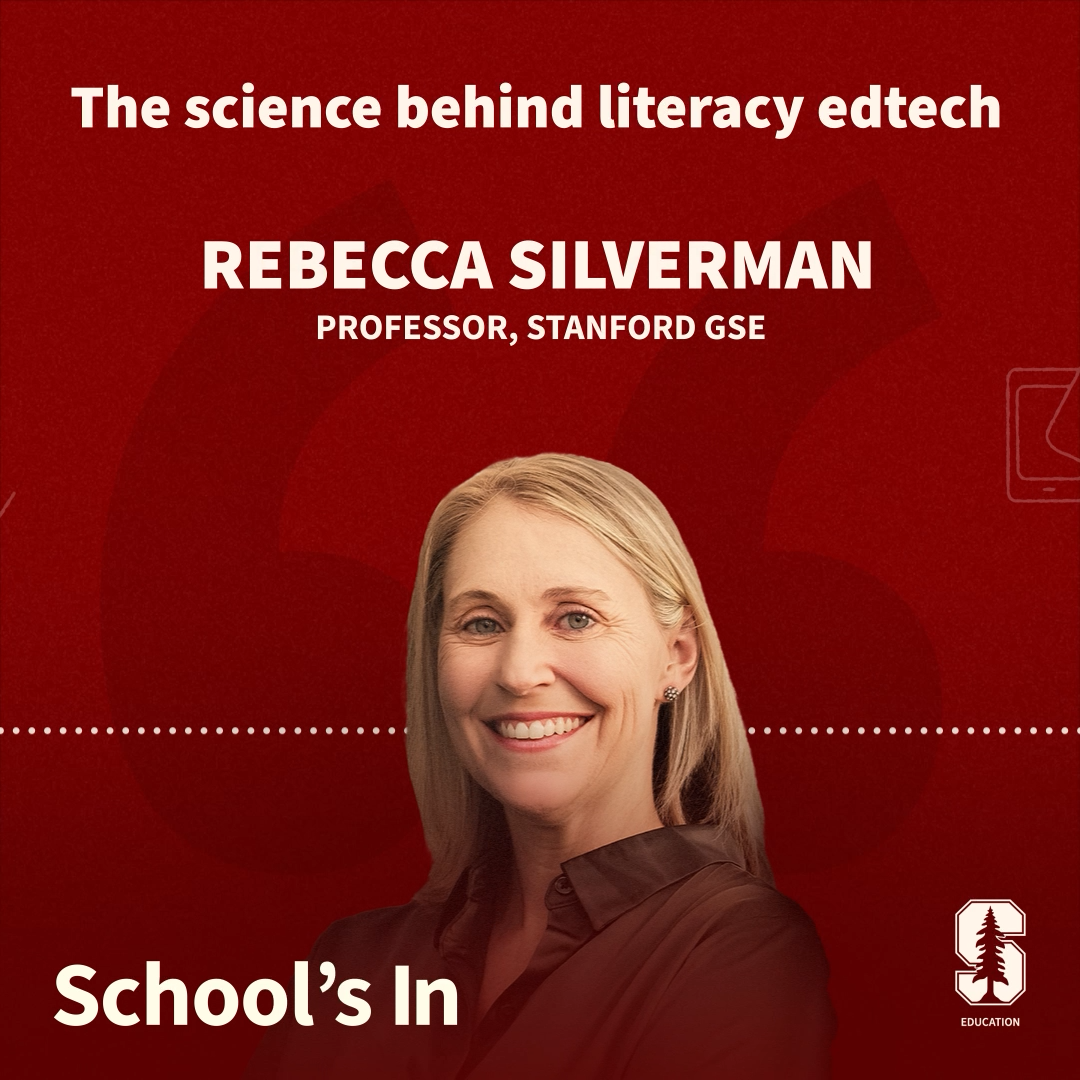
When it comes to literacy, digital learning products—known as educational technology or edtech—can be effective, but that depends a lot on their design and the skills they target, according to Stanford Professor Rebecca Silverman.
A former elementary school teacher, Silverman conducted a study examining more than a decade worth of data on products promoted as literacy learning tools. The technology has promise, especially in helping teachers identify children who develop at a different pace.
“Edtech can really help target where they are in ways that can help them practice and improve,” Silverman told School’s In co-hosts GSE Dean Dan Schwartz and Senior Lecturer Denise Pope.
But buyer beware: effectiveness varies widely.
“The effect sizes ranged from very positive to negative” meaning, in some cases, “kids should have been maybe doing something else during that time,” she said. “That’s where we really wanted to dig in and understand more.”
Two components of literacy are: decoding, or being able to read the words; and comprehension – the ability to understand the words being read. In general, Silverman said, edtech programs that “provide more practice, more feedback, and are more explicit and systematic” are better for learning decoding while programs that are “more immersive, more scaffolded” are well suited to improving comprehension. Immersive programs let kids practice skills and then apply them in context.
“There are different kinds of programs that might be effective for different skills” she said. “That’s something we should pay attention to.”
Addressing the trend toward gamification – Schwartz shared two of the most “outrageous” edtech games he’s seen at the Stanford Accelerator for Learning – Silverman said that, while games can help engage children in a task, too much of a good thing is still too much.
“One of the things that we’re constantly thinking about is that balance between getting the skills integrated, focusing on how to support the skills, but also making it fun and engaging for kids,” she said. “It is a careful, delicate balance between the two.”
Rebecca Silverman (00:00):
Are we really covering all of the different parts of literacy with the edtech programs out there?
Denise Pope (00:08):
Welcome to School's In, your go-to podcast for cutting-edge insights in learning. From early education to lifelong development, we dive into trends, innovations, and challenges facing learners of all ages. I'm Denise Pope, senior lecturer at Stanford's Graduate School of Education and co-founder of Challenge Success.
Dan Schwartz (00:31):
And I'm Dan Schwartz. I'm the Dean of the Graduate School of Education and the faculty director of the Stanford Accelerator for Learning.
Denise Pope (00:41):
Together we bring you expert perspectives and conversations to help you stay curious, inspired and informed. Hi, Dan
Dan Schwartz (00:51):
Ms. Pope.
Denise Pope (00:52):
How's it going?
Dan Schwartz (00:53):
It's good. Does Ms. Pope make you feel like you're teacher?
Denise Pope (00:57):
Yes. [inaudible 00:00:58]-
Dan Schwartz (00:57):
Ms. Pope. Ms. Pope, over here.
Denise Pope (00:59):
People don't call me Ms. Pope anymore, so that, yes, I feel very teachery, which is good 'cause I have a question for you. This will be easy though. This is not a hard question. You, in your lab, have worked on many different edtech projects. Do you have your favorites? Some are the most outrageous? Some of the most exciting?
Dan Schwartz (01:18):
I love all my children, so-
Denise Pope (01:20):
Yes. Of course. Of course.
Dan Schwartz (01:20):
... there's no favorites, but, uh, I'll give you two outrageous ones. One was we took, uh, an old video game called Space Invaders and we changed it to teach about statistical properties, and your job was to shoot down, uh, space aliens.
Denise Pope (01:38):
Hmm.
Dan Schwartz (01:39):
So that was pretty outrageous. Uh, it worked. It prepared students to understand the concepts better. The other one, which, uh, was built on a very successful technology called a Teachable Agent. And so the way it works is the child teaches a computer character, and then the computer character can answer new questions on its own. And so the kids would teach their agents, and then their agents would go into a game show. And so, they'd name their agents, so we two would be one of the agents and there'd be three others. And then there was a game show host who had asked, say, "I'm going to ask this question of the agents." And each kid had to bet on whether they thought their agent would get the right answer or not, so the goal was to get them to reflect on what they had taught and whether it was adequate for the question. And so, I'm not sure gambling was a great move here, uh.
Denise Pope (02:28):
(laughs) Yeah. Shooting, we've got gambling. Oh my goodness. Well, w- how... And, and you think of these... How do you come up with these?
Dan Schwartz (02:36):
So I, I tend to work in STEM domains, science and math, and there, you're sort of trying to find what is the thing that the student really needs to learn, where the technology's gonna help you because it might... There's something about it that's hard and the technology lets you do things that you can't do otherwise. I think it's probably different for other domains. You know, if I'm thinking about reading comprehension, it might be something quite different, but I, I'm not sure. Fortunately we have a guest who can answer this.
Denise Pope (03:06):
Awesome. Tell us who we've got?
Dan Schwartz (03:08):
Today our guest is Professor Rebecca Silverman at the Graduate School of Education, the Graduate School of Education at Stanford. She started her career in education as an elementary school teacher in her hometown of New Orleans, Louisiana. And so here at Stanford, she studies how to support struggling readers from all language backgrounds and how to identify solutions. So, Rebecca, thank you for joining us again.
Rebecca Silverman (03:32):
Glad to be here.
Denise Pope (03:33):
Yes, welcome.
Dan Schwartz (03:35):
So, uh, Rebecca, you know, I've, I've focused more on STEM than literacy and I... But I, I was wondering, are there interesting literacy technologies to help students learn to read and write?
Rebecca Silverman (03:47):
Absolutely. I think one of the most promising things that technology can do in the area of literacy is really differentiate for kids who have different learning pathways in literacy. Uh, a lot of kids, uh, develop a different race in literacy and edtech can really help target where they are in ways that can help them practice and, and improve in literacy, and I think that's really promising direction.
Dan Schwartz (04:09):
It can differentiate and then adapt. Tough for a teacher of, I don't know, 30 kids to, to do that for each kid by hand.
Rebecca Silverman (04:19):
Yeah. So, teachers have large classes. They're trying to make sure they're meeting the needs of all students. Students have needs in areas of word reading, also comprehension. It's a lot of work for them to differentiate. And edtech can help them, not supplant the teacher, but supplement the instruction by providing some additional differentiation and also providing a tool that they can use while they're meeting with kids and providing their own personalized differentiation.
Denise Pope (04:44):
It's so funny 'cause I, when Dan asked that question, what came to my mind, we're sort of like, "Oh, you're reading along and something pops up," or you're reading and all of a sudden the picture moves. Or I, I don't know. I was thinking more like, literally when you're reading, what is the technology doing?
Dan Schwartz (05:01):
So Denise, you know what I was thinking,
Denise Pope (05:03):
What?
Dan Schwartz (05:03):
That words show up and you have to kill one of them-
Denise Pope (05:06):
Yeah. Exactly.
Dan Schwartz (05:07):
... to win the game.
Denise Pope (05:08):
Exact- Shoot the word and then like it explodes and tells you the answer. So we're, we're way off, huh, Rebecca? Are we way off?
Rebecca Silverman (05:15):
Not necessarily. I mean, there are games where you are, you know, really focused on words and, and putting words together. And uh, you know, it could be putting balloons together in a balloon constellation where you're putting together the words, but it could also be a much larger game where kids are really, um, going after a quest and they're trying to solve problems.
Dan Schwartz (05:33):
That second one's really interesting.
Rebecca Silverman (05:35):
Yeah.
Dan Schwartz (05:35):
Where it's, uh, sort of make your own adventure kind of thing, or choose your own adventure, except it's actually kind of a video game quest that you have to do lots of reading. Is that-
Rebecca Silverman (05:45):
Yeah. And, and one of my first interests in this was watching my son play video games and learning a lot from having to, uh, read and comprehend what was on the screen. He played Zelda a lot as a kid, and there was a lot of content in Zelda and he had to comprehend it in order to get to the next part of the quest. And I think games that have that, they both, uh, support engagement and motivation, and they're kind of getting kids to comprehend for a reason they have to solve a problem or, or get to the next level.
Dan Schwartz (06:11):
I know this guy who made sort of a commercial grade video game to teach algebra, and he never figured out how to get the algebra in the game.
Denise Pope (06:20):
Oh (laughs).
Dan Schwartz (06:21):
So you, you'd like play, you'd play the game and then it would stop and you'd get a sheet of word problems that you had to solve, so you were allowed to go to the next level.
Denise Pope (06:29):
Oh, that's not good.
Dan Schwartz (06:30):
I know. That hurt. That, that hurt, you know [inaudible 00:06:35]-
Denise Pope (06:34):
No. But what Rebecca's talking about is really, really cool.
Dan Schwartz (06:35):
No. It's really integrated. It's part of the story, so that's good.
Rebecca Silverman (06:38):
Yeah. And I've worked with the nonprofit sector of edtech on working on programs and transmedia content on literacy, and one of the things that we're constantly thinking about is that balance between getting the skills integrated, focusing on how to support the skills, but also making it fun and engaging for kids. And it, it, it is a, a careful, delicate balance between the two that really, you know, people need to think about when they're making these programs.
Denise Pope (07:03):
And I know that just reading science overall, the science of how to learn to read has been over the years a little bit controversial and maybe changing and whatnot. So how much does the science come into designing the products and how do you know as a researcher?
Rebecca Silverman (07:20):
Yeah. So I mean, we know a lot about how to teach kids how to read. And one of the things that is really important for edtech programs to do is really look at that research and understand what do we know on how, you know, teachers teach kids to read? How can we use that as a foundation for edtech tools? Um, and then we need to think about, uh, based on the different skills that we're targeting, there might be different ways of focusing on those skills that differ depending on, uh, what, what we wanna work on. And so like something like decoding, which is putting the letters and sounds together might be much more explicit and much more like a game where you're, you know, s- doing one thing, putting one letter and one w- one word together. But then if you think about comprehension, that's gonna be a much bigger space and a much more interactive, um, experience. And so thinking about what do we know from the research to design the game, and then how do we address the skills that we wanna target effectively based on the, the research?
Denise Pope (08:15):
And I know you've just done a study that looked at the effects, right? Of a whole bunch of different kinds.
Dan Schwartz (08:21):
Yeah. So let me ask, I'm a school district, I'm a teacher, I'm a parent, and, uh, the market's flooded with these products, and so I wanna know which one works. At the same time you are at a research one university and you probably want to know which features make the difference, so you can generalize from one good program to the design another. So how do you do this? Do you, you know, go home and play every game?
Rebecca Silverman (08:50):
That would be fun.
Denise Pope (08:51):
Yeah. And she has her son do it too. Yeah.
Dan Schwartz (08:54):
[inaudible 00:08:54] geez, Mom, would you just come out and talk to me?
Rebecca Silverman (08:57):
That would be fun. But, uh, yeah, I mean, I think a lot of the, the motivation for doing this project was that teachers in school districts were asking, you know, "What tools should we be using? Should we even be using these tools?" And so what we did was we looked across all of the studies that had been published in the area since around 2010 on edtech programs in the area of literacy, and we compared them in a way that we could understand what was more effective than other programs. And, um, we're able from that approach to get kind of an average effectiveness, but then we're also able to see the, the range and, and what varies. And then within that we can actually look at what features might be associated with higher effects, so that's what we did in that study.
Dan Schwartz (09:39):
So you basically get your graduate student to go find 120 studies that have already been conducted, and then you aggregate those studies and sort of say, "This study had this feature, this feature, this feature. This study had feature X, Y, Z, and it looks like 12 of the studies had feature X. Did it work? Did feature X work in all these different studies?" Is that sort of how this works?
Rebecca Silverman (10:05):
Yeah. I mean, we started with a database. The database had thousands of articles that purportedly focused on edtech and literacy. We looked at those very carefully because the other part is understanding what research is actually done well. And so we looked at the designs of the research, making sure that the studies were high-quality research studies, and then that's w- exactly what we did. We coded the studies for the different features that they had, and we looked at the, the actual effects of the programs and used that data in a way that we could compare across programs to get a sense of what the general effects are if we were to just say, you know, programs in general, what is the effectiveness of these programs?
Dan Schwartz (10:42):
So how much work is that? You know, so like I go out and I, I make some goofy game and I take it into a classroom and half the kids get to use it and half the kids use something that's really bad, so I can be sure that mine's better.
Rebecca Silverman (10:54):
(laughs)
Dan Schwartz (10:54):
And that that takes me, you know, like a couple of weeks. And then I analyze the data and, and then, you know, the rest of the time's trying to convince people in a paper that it was interesting, but like how a... That sounds so grueling to me to go through all these papers and weed them and-
Rebecca Silverman (11:07):
It, it's very time-consuming. We have now technology tools that can help us (laughs) code these things and, and pull data out of the, the papers. But yeah, it's a grueling process, but it's an important one because no single study is gonna give us enough information to be able to answer a question like is edtech effective for literacy? So, really looking across the body of research is, is how we need to do that.
Dan Schwartz (11:29):
So that's important. Why wouldn't one single study, you know, once and for all... I, I did a study on aspirin once and for all and it turns out it get- gets rid of headaches. You know, why, why do you need lots of them?
Rebecca Silverman (11:41):
So anyone's study is gonna be based on that context, the population, the way that the study was implemented, you know, how long the, the program was used, all of these different factors. And so, what we find the results of any one study might be based on the specific context or content of that one study, so we need to look across studies to see in general, across different programs, across different study designs, are we seeing effects similarly? And if it, if they are in a similar direction, then we could feel more confident that, yes, it is edtech in general that is, that is either supporting or not supporting rather than a specific program or a, a specific context.
Denise Pope (12:20):
So you did all this work, and you must have found some very exciting things. Tell us about what you found?
Dan Schwartz (12:26):
Oh, I know what you found. She found the games where you gamble or shoot-
Denise Pope (12:30):
(laughs)
Rebecca Silverman (12:30):
(laughs)
Dan Schwartz (12:31):
... lead to the best outcomes. This is-
Denise Pope (12:34):
The best. The best readers. (laughs)
Dan Schwartz (12:34):
Yeah. The best readers.
Denise Pope (12:35):
When you gamble and shoot, you read better. I don't think so. Rebecca, please tell us that is not what you found.
Rebecca Silverman (12:40):
Yeah. And interestingly, d- we didn't code for gambling and shooting. (laughs)
Dan Schwartz (12:42):
(laughs)
Denise Pope (12:44):
(laughs) Shocking.
Rebecca Silverman (12:44):
I'll do that next time. So I think the, at the highest level of kind of what we found, we did find in general, edtech programs are effective at supporting literacy. When you dig a little deeper into that, we found a very wide range of effectiveness. And so you can, in this kind of meta and analytic approach, you can compare the effectiveness of programs from different studies. And what we saw is that the effect sizes ranged from very positive to negative, and so kids should have been maybe doing something else during that time. And so that's where we really wanted to dig in and understand more about what's, what's going on in these different studies.
Denise Pope (13:19):
So, what... If you, if you look at these and you started to dig in, I know you were looking at different things. You mentioned decoding as one, which is just like learning how to read, and comprehension is another. Were there other things that you were looking for?
Rebecca Silverman (13:34):
Yeah. The, the big thing is, um, really comparing the effectiveness of these programs for these two big constructs of reading that we think about as really being essential to being able to read. One is, as you said, being able to read the words, and the other is then understanding the words. And so we wanted to see, first of all, what programs have been studied that look at these two different dimensions of reading, and then what is the effectiveness for these two different dimensions? First of all, there's a lot more programs that are focused on decoding than there are on comprehension probably because decoding is a much more constrained skill, and so therefore it's a little bit easier to target. And the effects were greater for decoding than they were for comprehension in general. So that made us really think about, you know, are we really covering all of the different parts of literacy with the edtech programs out there, at least the ones that have been studied?
Dan Schwartz (14:28):
So Rebecca, what, what are some of the things you found, you know, some of the specific insights that maybe are quite important for designing or purchasing these? And then I need to know what were surprising things. But let's start with sort of what are the, the big findings that came out of this, this work?
Rebecca Silverman (14:48):
Sure. So, so one of my main focuses in study was really, again, that looking at the difference between programs that can support decoding versus comprehension. And one of the things that we found is that programs that provide more practice, more feedback and are more explicit and systematic are really effective for decoding. And on the other hand, programs that are more immersive, more scaffolded and also provide feedback are more effective for comprehension. And so, the message that I'm getting there is really that there are different kinds of programs that might be effective for different skills in literacy, and that's something that we should pay attention to when we're thinking about purchasing programs or using programs with kids.
Denise Pope (15:28):
So my son actually used a program to learn how to read. The teacher suggested it. I would've never even thought to do it. And it was definitely, I think a decoding program. But I don't know, there seemed to be also a little comprehension in there. So if they show a picture let's say of a cat and then they put the C, and he had to find ways to get the A, T connected to the C. and when he did, it would be like, "Yay. Good job. Balloons, et cetera." So, to me that's decoding 'cause like c- at, right? But also he had to know that that was connected to the picture of the cat, or no? Is that not comprehension? What... Does that make sense? (laughs)
Rebecca Silverman (16:06):
Yeah. I mean that, that would be minimal comprehension just to be able to recognize what the word cat means. The, the focus o- of that activity I think within that program is, is on decoding.
Denise Pope (16:15):
Okay. And you're saying that's easier to do. There's ways to make it fun for kids to practice. I mean, he definitely would not have just done that if there weren't sounds and balloons and get up to the next level and, you know, prizes in that sense.
Rebecca Silverman (16:27):
Yeah. So something like decoding is very skills-focused. Like if you were thinking math, like, you know, learning your math facts. It's kind of similar. You need to be able to have a lot of practice, a lot of very explicit feedback kind of in a systematic and, and sequenced way. And so, programs that do those things are likely to support decoding in a way that can be effective, and then the like gamification so that kids are engaged and motivated to, you know, kind of level up and that kind of thing. That can be effective. However, we have found that too much gamification can actually get in the way of kids being able to learn from the program, and so you need to find that balance of like not too gamified, but gamified enough to keep their interest.
Dan Schwartz (17:05):
It's interesting. Why? What happens? They, uh, they stop paying attention and they're just trying to get the points?
Rebecca Silverman (17:12):
Yeah. And they get distracted. Yeah.
Dan Schwartz (17:13):
Yeah. Yeah. So I, I would make the split that on things that are, you want automaticity, like driving a car where you want to be able to shift and turn on your signals. These are really good for that quick turnaround feedback drill. You practice a lot. You know, a highly repetitive, stable environment. You know, text always shows up left to right and in English. But the, the comprehension is tougher, right? Because there each, each, each thing you comprehend is kind of new. Whereas cat, it's like, "Yeah. I've seen the word cat 1000 times. Thank you letting me practice that." But comprehension, each time it's new so th- so I can see why that's, uh, more narrative, more sort of s- sustained, immersive where you really understand what it means to develop an understanding maybe.
Denise Pope (18:03):
Is there an example of, of one that teaches comprehension, Rebecca? Just so people can have it in their heads.
Rebecca Silverman (18:09):
Yeah. So one of the programs that's been most effective is an intelligent tutoring program that uses explicit feedback and scaffolding. The embedded tutor is looking at the kids' responses to different questions about passages that they're reading, and based on those responses, helping kids fine tune those or, or think of strategies they can use to deepen their response to those questions. And so, those kinds of programs are gonna be much more looking at that scaffolding piece, that providing, you know, in-depth feedback so that kids can comprehend at a deeper level. And then giving the kids strategies to think at a greater macro level, not just at a, you know, particular word, but really thinking about overall in a passage what is the author trying to say? What is the message I'm trying to, to extract here?
Dan Schwartz (18:53):
So one of my favorite studies on, uh, early reading sort of showed that you need to tell the kids that jobs to sort of make a mental model of what's going on. So there's a goat goes into a barn. You know, a pig goes on the roof. Can the goat see the pig? And you want the kid to be making a model of this, but they didn't know that was what they were supposed to do when they read 'cause they, they thought my job's to read the words.
Rebecca Silverman (19:18):
Hmm.
Dan Schwartz (19:19):
And so, I thought that was really interesting. It was just... I mean it's, it's kind of a meta strategy I guess for comprehension, but they didn't know, and you sort of need to teach 'em this. And so I can imagine there's lots, lots and lots of strategies that we use to, to read. I probably don't even know how many I'm using.
Rebecca Silverman (19:35):
Yeah. So some of these programs that, that do that and that focus on strategies are focused on things like, how does the organization of the text enable me or help me comprehend? So how the text is organized. Can... I can look at how a text is organized and think about how the organization can help me comprehend, and so looking at text organization is one strategy.
Denise Pope (19:55):
What does text organization mean, Rebecca?
Rebecca Silverman (19:57):
So text structure for narratives is kind of beginning, middle of end. There's gonna be an introduction or problem, a solution. And kids can think about those different pieces of what a typical narrative looks like to help them comprehend. Whereas for something that's more nonfiction, it's gonna be, you know, something's introduced, there's given details about that, and then more information that I can connect back to the main topic sentence. And so, then I can think about that organization could be a compare-contrast. Uh, it could be a, uh, in different organizational structures within expository text that I can hook onto to help me comprehend.
Dan Schwartz (20:30):
So, Denise, I, I think it's amazing how much of my reading skill I take for granted.
Denise Pope (20:35):
Oh, yeah.
Dan Schwartz (20:36):
That there's all these, all these things that I'm probably using and doing and it... I just don't even think about it. I just sort of do it. And then to decompose it and say, "No. These are all the different moves." This is really a, an interesting challenge for the, the designers of these programs or for the field of reading research in general to say, "No. These are different strategies that people use."
Denise Pope (20:57):
Totally. And then if you think about fiction. I mean, so my husband and I were just having this conversation because I read a book, I thought he would really like it. And it's a kind of book that it jumps back and forth in time and different narrators narrate different chapters. And he's like, "I can't keep that all in my head," but think of what the brain has to do to be able to like go, "Oh, wait. That was before, and now this is after. And this person's talking now, and now we h-..." But like y- I was able to do it seamlessly. (laughs)
Dan Schwartz (21:27):
H- have I told this story about my dad? So he, he's reading this book and he says to me, "You know, I'm on chapter six, and I'm, I'm, I can't put it together."
Denise Pope (21:36):
Oh.
Dan Schwartz (21:36):
"I've tried all these different structures to put it together, and I just, I can't figure it out." And he, he reads another two chapters and then he... I see him the next day and he says, "Uh, it turned out to be a book of short stories." (laughs)
Denise Pope (21:49):
Oh. (laughs)
Dan Schwartz (21:49):
But I bet he used every strategy you could think of to try and find a structure there.
Denise Pope (21:54):
Reading is complex. Doing these things, we're doing it without even knowing we're doing it half the time. We've got this technology to, to coming up in different ways to help different pieces of it. If you were a parent or a teacher or an administrator out there, based on what you found in this meta analysis, what are some of the takeaways?
Rebecca Silverman (22:14):
I think one takeaway is parents and teachers can be looking at different features of programs to try to understand are those gonna be help for what I want my child to be able to accomplish? And so, if we're focused on decoding, there're gonna be programs that have lots of practice, lots of feedback, lots of, um, explicit instruction, uh, for, uh, comprehension. It'll be that it's more immersive, has scaffolding and I wanna be thinking about are these features appropriately targeted for the level that my child's at? So, having some sort of adaptability so that as my, my child's progressing, the program will really react to and, and adjust to kind of the strengths and needs that my child might have.
Denise Pope (22:52):
Can you just say what you mean by immersible again? Immersibility?
Rebecca Silverman (22:56):
Immersive means that, uh, we can do things in isolation, so we can practice particular skills in isolation in a, a little game format, and then it also puts it in a text so that it's more like a reading experience. If I just play the game that's not in connected text, then, then I might never really associate that with the active reading itself. And so, making that kind of, um, play the game and then put it in context is really important.
Denise Pope (23:20):
That's helpful. Thank you.
Dan Schwartz (23:22):
All right, Denise. What, what are your takeaways?
Denise Pope (23:26):
Well, I am excited to know that there is some technology out there that actually is working to help kids, right? Because sometimes you just wonder is there just a lot of junk out there and people are just trying to make money and get schools and parents to buy stuff? So, I'm really glad that Rebecca did such a comprehensive study, this meta-analysis, and found positive results. And I also am fascinated by the difference between the technology that can help someone decode and because it's a little bit simpler and not simpler to do, but simpler to build the tech for, right? That she's seen some really good results. And I'm also mindful of the like, uh, too much gamification may, may negate some of those results, which is not something that you would normally think about, right? So I, those were all kind of fascinating to me.
Dan Schwartz (24:18):
Can I just say that once and for all, uh, I do not advocate shooting aliens or gambling for children.
Denise Pope (24:24):
Thank you.
Dan Schwartz (24:25):
These were the most outrageous things I've done.
Denise Pope (24:26):
Okay. (laughs)
Dan Schwartz (24:27):
But I do not promote those as means of gamification.
Denise Pope (24:29):
So what, what a- what's-
Dan Schwartz (24:31):
[inaudible 00:24:32]-
Denise Pope (24:31):
... your takeaway from this, Dan?
Dan Schwartz (24:33):
The right tool for the right job.
Denise Pope (24:35):
Yep.
Dan Schwartz (24:35):
You know, and, and it's good to know what the different jobs are. Uh, one thing I'm missing is, uh, if I'm a consumer, how do I know which packages are good? You know, so I remember going to the app store to get some support for a kid and you know, the things that go up first are things that have a Star Wars character. I didn't really know how to pick which ones are effective, so that would be something... I don't know. Is your meta-analysis... Are people gonna be able to take the meta-analysis and go, "That's the software I wanna use"?
Rebecca Silverman (25:08):
Not necessarily. I think turning to programs like Common Sense Media that review programs and do have some kind of criteria based on research for what they're looking for in their review, that can be a really good resource. Also for teachers, there's a resource with the Elementary and Secondary Act that has reviews of different programs and reviews of research on those programs, so those would be great sources. But in general, we, we need more research. I mean, I think, uh, um, a big takeaway for me was that there's not enough independent research on a lot of these programs, and so it's hard to know whether or not they're effective. So, advocating for research on these programs, like we would ask... You know, we would want our medicine to be studied in, in research, so we would want our educational programs to be studied in research.
Dan Schwartz (25:51):
That's great.
Denise Pope (25:52):
Super exciting, Rebecca. Thank you so much for being here and for really helping us understand the newest, uh, latest technology when it comes to literacy. And I wanna thank all the listeners for joining this episode of School's In. Be sure to subscribe to the show on Spotify, Apple Podcasts, or wherever you tune in. I am Denise Pope. (laughs) I tried, I tried... to do that like c- a- at. I'm D- e- nise Pope. (laughs)
Dan Schwartz (26:18):
That's (laughs) that's really good.
Denise Pope (26:18):
(laughs)
Dan Schwartz (26:24):
Uh, everybody knows who I am.
Faculty mentioned in this article: Rebecca Silverman