AI and the future of human learning
What are the promises of AI in education? What are its shortcomings? Will AI displace teachers, or make teaching a more desirable job? And what about AI and cheating?
These are some of the questions School’s In explored – with audience participation – at a live recording in front of a crowd of nearly 1,000 at the Los Angeles stop of Stanford’s Open Minds tour, a series of gatherings highlighting the university’s future.
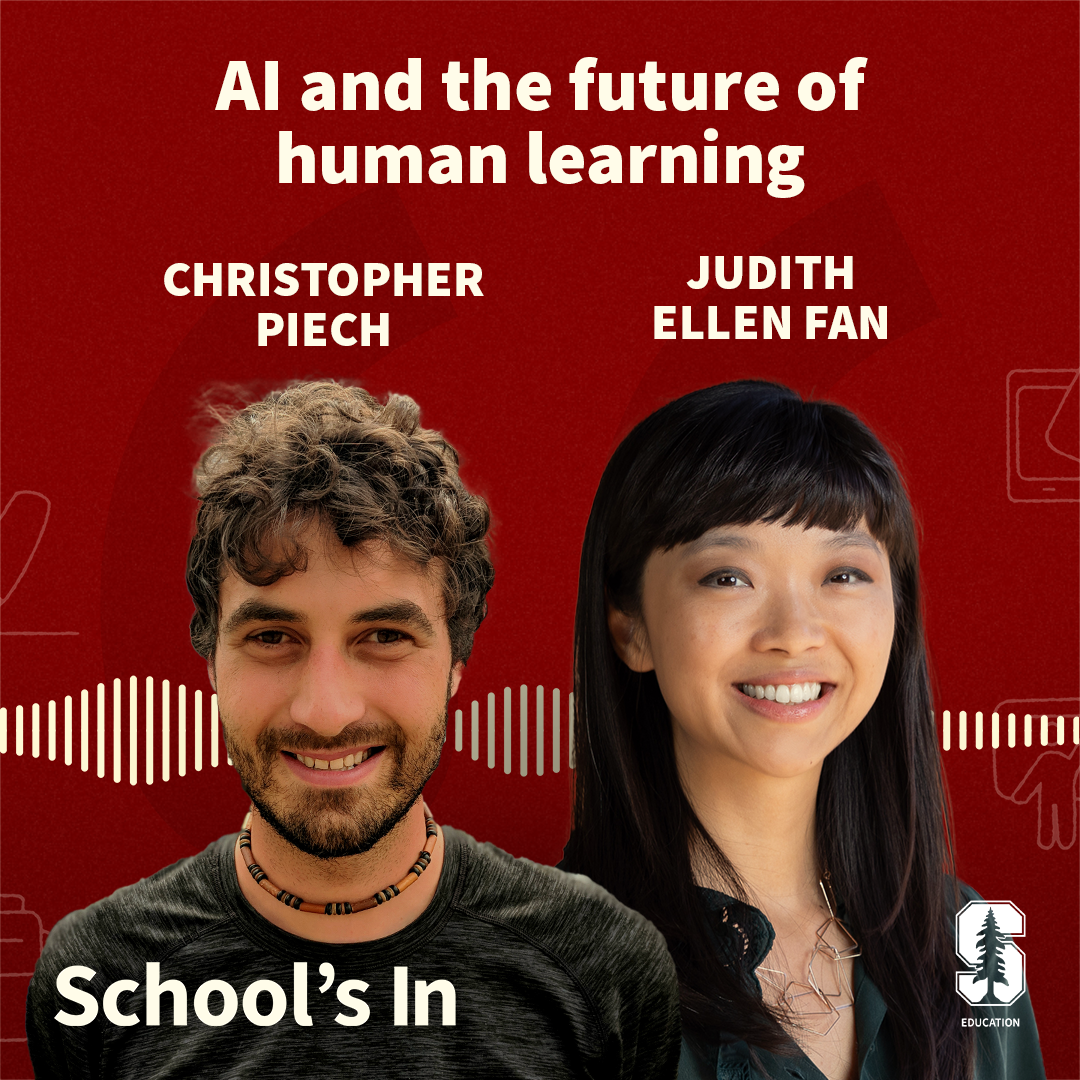
Hosts GSE Dean Dan Schwartz and Senior Lecturer Denise Pope led a lively discussion about the many ways AI is reshaping education with Stanford faculty members Chris Piech, a computer scientist, and Judy Fan, a cognitive scientist.
“I was nervous,” Piech said about the arrival of generative AI in his field. “I think a lot of educators were wondering how we’re going to adapt to all this change.” Would people still want to learn to code? “We were ready for a smaller class.”
Instead, demand for the free online version of his popular introductory coding class surged, with tens of thousands of students applying from around the world. Piech says students are becoming more efficient, creative, and entrepreneurial, using AI as an accelerator rather than a shortcut.
Fan’s research explores how humans think visually – and how today’s AI struggles with diagrams, sketches, and multimodal reasoning. “That’s a problem if we want to build systems that truly support human thinking and learning in the real world,” said Fan, whose lab is working on diagnosing and fixing these failures.
The panelists also tackled one of the most common fears about AI in education: cheating. Research led by Stanford scholars suggests that while cheating has not increased with the advent of generative AI, students are now using different tools. The challenge of adapting teaching and assessment in an AI-powered world involves designing motivating learning experiences and continuing to prioritize interpersonal connection.
And it’s the deeply human elements of learning that remain essential in capitalizing on AI’s potential.
Piech said he hopes AI can make education more adaptable for different types of learners. “Education hasn’t always worked for everyone,” he said. “We have a moment where maybe we can create that sort of education that would work for more people and would allow people to hit higher heights.”
“It is not foreordained how AI will impact education. It’s up to us,” said Fan. “The learning environments that we build express [our] values and give dignity and agency to our lives. And we can actually build a world that we want our kids to grow up in.”
To view the video of this live episode, visit our School's in YouTube playlist.
Dan Schwartz (00:01):
Hi, Denise. Today is special. Do you know why?
Denise Pope (00:05):
I think I do. We are here taping live in Los Angeles for a special event called Open Minds.
(00:15):
Welcome to School's In, your go-to podcast for cutting-edge insights in learning. From early education to lifelong development, we dive into trends, innovations, and challenges facing learners of all ages. I'm Denise Pope and with my co-host Dan Schwartz. Together we bring you expert perspectives and conversations to help you stay curious, inspired, and informed.
Dan Schwartz (00:40):
So, uh, Denise, I'd like to take advantage of the real-time input to the show. Uh, this is, uh, for our listeners on the podcast. We usually don't get audience opinion, although that's something we've wanted to change. So you, you clap if you agree with a statement. And the statement is, AI is the WD-40 for education. Lemme try it the other way.
Denise Pope (01:04):
(laughs) Okay.
Dan Schwartz (01:05):
Uh, clap. If you think AI is going to make education worse. (laughs)
Denise Pope (01:13):
What are these questions, Dan? We're, (laughs) what are you having us clap for?
Dan Schwartz (01:17):
Let me introduce our audience. So, uh, we have Chris Piech, who is a computer science professor and wielder of AI. And we have Judy Fan, who is a psychology professor whose expertise is in cognitive science and how people know the world. So, uh, we gotta do one question before we get to you, Chris. Clap, if you took 106A.
Denise Pope (01:41):
Computer Science 106A.
Dan Schwartz (01:46):
So Chri- Chris is, uh, a beloved 106A teacher. He's also the beloved teacher of Math for AI. Ha- hard to imagine there's a beloved teacher for that.
Denise Pope (01:56):
(laughs)
Dan Schwartz (01:57):
So, so Chris, you and I talked about this when the GenAI just showed up a couple years ago, and one of your concerns would be a loss of motivation to take CS. And then a second concern is that, uh, students might be lazy and use AI to do the problem sets. So a couple years later, what do you think?
Christopher Piech (02:14):
I was nervous. I think a lot of educators were wondering how we're gonna adapt to all this change. You know, a couple vignettes. One is I get the chance to teach this free online class and we say, who wants to come learn computer science? And we were about to go teach it to the world. And GenAI was there wondering who would want to learn at this moment when all the news was about jobs disappearing and you don't need to learn how to code 'cause AI can code. And we were ready for a smaller class, but instead we had twice as many people apply. We had 71,000 people say like, "Yes, please, teach me computer science." Uh-
Denise Pope (02:46):
Wait, 71,000?
Christopher Piech (02:46):
Yeah, 71,000. So we said, "Hey, we'll have some fun. We'll learn. And also, while you're learning to program, you are learning to think." Now at Stanford too, um, I would say that students are so adaptable, I would never underestimate them. Uh, the way that they approach this new challenge has been quite inspiring. Sometimes it looks like they are going to learn in more efficient ways, but sometimes I'd say now it's awesome and they become very entrepreneurial. They're like, "Hey, on some level, this is the most fun time to ever program. It's the most fun time to ever do mathematics. When I learn the core principles, I can produce 10 times as much. If I get a couple friends who are inspired by the same cause we can make something together."
(03:30):
And I was saying, I had office hours just before I flew out here to LA on Friday night. And it was just filled with students coming with really principled and beautiful ideas. I have a student who is a world famous conductor, and then he took a probability class. He got really excited about this idea of making it so that when people are l- learning to play an instrument like the, a recorded orchestra can slow down as they need to focus on notes. And with some core principles and this excitement of the moment, he was able to go turn around and create things. And I feel like that's what I'm seeing on campus is just a lot of creation.
Dan Schwartz (04:05):
So the students, do they take a second computer science course or is it just 106A? Because this is-
Denise Pope (04:09):
(laughs)
Dan Schwartz (04:10):
... this is a beloved course.
Christopher Piech (04:11):
Yeah. You know, I, I also teach this math for computer science class, which incredibly fun, like, come learn probability. You might not think it's as fun, but it is. We could talk about all the different ways you could apply technology to science through this language of math. And yeah, people are having fun learning that. On some part, not just because they're so curious about what they can create, but also because, you know, AI has become a very important tool and a lot of people wanna know how to use it.
Denise Pope (04:38):
I am excited to hear, Chris, that people are embracing it in really good ways. I think a lot of people, you know, myself included, are sort of worried that AI is gonna write the essays instead of the students doing the writing, and we're gonna lose that struggle that we need, the cognitive struggle. Judy, you look at thinking that involves more than words, right? So I would love to hear you talk about how AI is used for this.
Judith Ellen Fan (05:03):
Thanks, Denise, for that, for that question. So as Dan mentioned, I am a cognitive scientist, so my focus is on human beings and how we think and learn. In my work, we ask how do people take ideas and turn them into images, then use those images to think new thoughts. So take for example, a chemist has an idea for a new drug and the diagrams they might sketch on the whiteboard. Or a football coach, uh, making a sketch to communicate to their team, um, the details of a new play or an economist trying to figure out what the heck is going on with the housing market. All of these different people are using diagrams and charts in all of these different ways. These powerful, versatile tools for making sense of things, communicating ideas in ways that are really difficult to express in words alone.
(06:02):
And what's really striking is that current AI systems, and this is even the frontier models, are really struggling with these kinds of visual displays. And that's a problem if we want to build systems that truly support human thinking and learning in the real world, including in classrooms. Because human thinking relies on integrating information from lots of different sources and not just text in order to connect the dots.
Denise Pope (06:32):
So Judy, I mean, this is, this is a big issue, right? So how are... Are you doing anything in your lab to be working on this problem? How, how, what are you doing?
Judith Ellen Fan (06:39):
Yeah, absolutely. So, um, in my group, we are trying to come up with solutions to this problem by conducting detailed analyses of where these AI systems are going wrong, poking their internal circuits to figure out what's causing those failures. And then coming up with ideas for how to make those systems work more reliably, and is important also in a way that's more interpretable and trustworthy.
Dan Schwartz (07:07):
So can I ask a practical question?
Judith Ellen Fan (07:09):
Sure.
Dan Schwartz (07:10):
Um, so a lot of people, uh, around me say that, uh, generative AI is going to ruin critical thinking, 'cause it, it'll write your paper for you. Uh, I don't quite understand that. I've usually thought through the critical parts of my paper before writing. But there is a place where it could help. So before I write a paper, I, uh, try and I, I get this sloppy theory and I try and think, can I get a visualization for this? Like, would a Venn diagram, how about a pyramid, clouds? You know. And so could I do this? Could I tell the GenAI, "Here are all my thoughts. Would you make a visual representation for me?" Or is this, this is just not there yet?
Judith Ellen Fan (07:50):
We're not there yet, but I think it's a beautiful vision. It sounds like your whiteboard looks like mine. Um, so I really think that something that, uh, is, is true about human creativity and the way that we think and reason. And also decades of work in educational and cognitive psychology has supported this idea that when people are grappling with really complex abstract ideas, it's really good to have options, words, pictures, numbers, code. All of these are really helpful ways of getting different angles and triangulating towards some new idea. And basically, AI systems are never going to truly support human thinking and learning if they're not able to participate in these multimodal exchanges using all of the information channels that humans naturally use.
Dan Schwartz (08:47):
So we've been talking about the student's perspective on this, and, uh, I wanna think a little bit about the teacher's perspective. And, uh, my favorite current story is a professor who told his class, "I'll tell you what, you write your essays with ChatGPT, I will grade them with ChatGPT and we can just all go to the beach."
Christopher Piech (09:06):
(laughs)
Audience (09:07):
(laughs)
Dan Schwartz (09:07):
Right? So, so, I, I, I sort of like that. But, uh, on the more serious side, I've got an audience question for you. Some people think that AI could displace the teacher. Other people think it'll make teaching the best job in the world to have this, this, uh, support. So here's the, uh, question for the audience. Uh, applaud if you agree with this, AI will make teaching a better job.
Denise Pope (09:31):
Ooh. I like that. They like it. They like it, Dan.
Dan Schwartz (09:38):
Yeah. Wait, wait till I ask this one.
Denise Pope (09:39):
Uh-oh.
Dan Schwartz (09:40):
AI will make teaching a worse job.
Denise Pope (09:46):
Oh.
Dan Schwartz (09:47):
So Chris, it's, it's sort of like you say, nobody really knows what the future's gonna bring on this one.
Christopher Piech (09:51):
(laughs)
Dan Schwartz (09:51):
Yeah. So Denise, uh, the cheating question.
Denise Pope (09:54):
Yeah.
Dan Schwartz (09:57):
It, it's like a big question. And you've done some research on this. I thought maybe you could share what you've been finding about the prevalence of cheating with, uh, appearance of the AI tools.
Denise Pope (10:05):
Sure, sure. So Challenge Success has been collecting data on academic integrity for years long before even the pandemic and before ChatGPT came really out in the public eye. And so we were in a really good position to do a sort of before the ChatGPT wave and an after and actually at the same schools. Even though not, the students were not all the same, but we had some overlap. And, um, let me just tell you, I don't know if this is gonna be shocking or not, but the cheating before ChatGPT and now... On our, on our survey, we list multiple ways that you can cheat. You can copy from someone's paper, you can plagiarize, right? You can use an unauthorized technological aid, uh, on an exam or an assessment. So lots of different ways. And the cheating rates before ChatGPT were in the 70% to 80%.
Dan Schwartz (10:58):
That hurts.
Denise Pope (10:59):
Yeah. I mean, and, and, and this, it was not just our study, lots of studies actually found very similar things. Now, to be fair, there's lots of different ways, you know, some of that was copying homework or working with a friend when the instructor said, don't do it. So, I mean, I'm not throwing all these kids under the bus. But then, what do you think? Let's say... Should we do a little audience clap? Clap if you think that after ChatGPT came out and others the cheating went up. Clap if you think it went up. Clap if you think it went down.
Dan Schwartz (11:32):
(laughs)
Denise Pope (11:36):
It stayed the same.
Christopher Piech (11:37):
(laughs)
Dan Schwartz (11:37):
(laughs)
Audience (11:37):
(laughs)
Dan Schwartz (11:40):
Sort of, that's sort of how the vote went.
Denise Pope (11:41):
I- it's-
Dan Schwartz (11:42):
It's half up, half down. Yeah.
Denise Pope (11:44):
Yeah. Half-half, right. I mean, they are using it more. So, so even though overall cheating rates are about the same, many, many more students are using the device for academic integrity in fractions. However, the overall use of kids using the device now is about 70% to 80%... Not using a device, sorry. The overall amount of kids who are using and experimenting with AI for academic reasons, not just for cheating, has really gone up. And so, our most recent numbers, about 80% of high school kids. And for teachers, it's actually much lower. It's about 30%. So we have a big gap. We have kids who are really experimenting and doing things both for good and maybe for not so good. And we have teachers who are really not taking on that mantle as much. So that's a worry of mine.
(12:29):
And then the other thing we're seeing and, and, and we go to schools all over the place. We put on professional development workshops on integrating AI into your classroom. We do parent workshops, you know, what do you do about AI? And there are a lot of real serious issues that we're seeing with AI around mental health and kids, you know, using chatbots to get advice and some cyberbullying, we have environmental issues and privacy issues. But there's a lot of good coming out of it that we're gonna talk about. And what we're finding is the kids are really confused because there's not very good policies.
Dan Schwartz (12:58):
So Denise, do you think teachers and students have the same definition of cheating? Yeah, assuming, assuming there's not a right answer, right.
Denise Pope (13:05):
Yeah.
Dan Schwartz (13:06):
Like, it's not two plus two equals four, but like on an essay or some more constructive project.
Denise Pope (13:10):
It's really confusing for the kids. What they will say is, "Well, we're not supposed to use AI, but they are allowing us to use Google to do research. And if you use Google, Gemini pops up. So are we breaking the rules? Are we not breaking the rules?" It's very confusing for them. And different teachers have different policies or just don't talk about it.
Dan Schwartz (13:28):
Don't talk about it.
Denise Pope (13:29):
Right?
Dan Schwartz (13:29):
Yeah. Yeah. No, that's the way I was with my son about other things.
Denise Pope (13:32):
Oh? (laughs)
Audience (13:32):
(laughs)
Dan Schwartz (13:33):
So, uh, so Judy, you teach, are you worried about it? Are you worried about cheating in your classes or you've set up something so it won't happen or?
Judith Ellen Fan (13:41):
Yeah, I've been following the same work that Denise just described, and I'm no more worried as a teacher now than I was three years ago. About two years ago in the introductory statistics course that I teach STAT60. Anybody?
Audience (13:56):
(laughs)
Denise Pope (13:57):
Yay.
Judith Ellen Fan (13:57):
Okay. (laughs)
Denise Pope (13:57):
Hey, Judy.
Judith Ellen Fan (13:59):
We started integrating problems into our problem sets that required the use of LLM products. We wanted to see how students would learn how to edit and critique code generated by an LLM. That became a learning objective for us. Um, when it came to assignments, we assign a lot of homework. All of our quizzes are take-home. The problem sets are, of course, done at home. And we encourage students to work with each other, to use Google Stack Overflow and any other resources they have at their disposal just as we expect they would in the real world. And come back and submit their work and really learn something. Now this quarter, what we're experimenting with is weekly one-on-one oral exams. We run these every Friday, and you have to sit down across a table in front of a TA, okay. And answer a question sampled at random from a quiz you already took.
Audience (15:06):
(laughs)
Dan Schwartz (15:08):
So I, I, I told you about this, that someone, so a lot of people come to me with their technological ideas and, uh, one guy has made a AI bot that it takes the teacher's face and then does the oral exam for the teacher.
Audience (15:21):
(laughs)
Judith Ellen Fan (15:22):
It's terrifying.
Dan Schwartz (15:23):
It's, you know-
Denise Pope (15:23):
(laughs)
Judith Ellen Fan (15:24):
That's a little scary. That scares me.
Denise Pope (15:26):
Chris, you're, you're teaching too, and, and, and I know that CS professors are often worried about cheating. What, what are you seeing? What's your take on this?
Christopher Piech (15:33):
I'm gonna build off what, uh, Judy said.
Denise Pope (15:35):
Yeah.
Christopher Piech (15:35):
Because we had a similar response. I've actually talked to a lot of people that in this moment of AI, when we all have these new affordances, the thing that will really distinguish great teaching experiences is the human touch. So also, like Judy, I have my students meeting one-on-ones every, uh, week. Um, so, and, and when we do code in place, like the special sauce is that we have a human mentor who is meeting with you. And this isn't just for getting great education, it's not just about plagiarism, it's also about this moment in time when some students are feeling lonely and they're looking for that mentorship. I really do think the special thing about maybe a Stanford education is not always just the problems you're solving, but also the people you're meeting along the way and those connections. So isn't that so ironic? We've been working on AI technologies for so long, but in this moment of AI in education, I'm putting my money in the human touch.
Denise Pope (16:26):
I love that. I absolutely love that. Uh, how are you doing? You're doing thou- you're doing a human touch with thousands of students?
Christopher Piech (16:32):
Yeah. You know, we do this yearly.
Denise Pope (16:32):
Do you sleep? You never sleep?
Christopher Piech (16:33):
(laughs) No. Yeah. You know, obviously one of the, when you're at Stanford, you could be meeting with a professor who is like, well established in their field, or you could meet with an older classman who's going to be the leader of the field of the future. Um, and I feel like this is a great way to accelerate the sort of one-on-one interactions we could have. So you meet with these peer mentors who are a little bit older.
Denise Pope (17:00):
Love it.
Dan Schwartz (17:00):
So social's important, and, uh, a lot of the concern about sort of replacing the teacher is you're not gonna be able to motivate the kid enough. So the social's there, you're interacting with a human, there's something at stake, you know, and so that amps it up. But I'm gonna place my bet on, uh, making tasks where students just don't want to cheat.
Christopher Piech (17:20):
Mm-hmm.
Dan Schwartz (17:21):
So like, uh, if I, if I'm inviting people over for dinner, I sort of don't want to say I cooked it, but then get it from the restaurant. I want to like, make it great.
Christopher Piech (17:30):
Yeah.
Dan Schwartz (17:30):
And so I think I can come up with assignments like that.
Christopher Piech (17:32):
Yeah.
Dan Schwartz (17:32):
You know.
Denise Pope (17:33):
So it's, that's exactly what we're doing at Challenge Success when we go into the schools, we actually say the teachers, when are the places in your classes or at your school where kids would never even think about cheating, right? They're putting on a play. They are, uh, c- creating a project that they're super excited about. Right? So motivation, engagement.
Dan Schwartz (17:51):
No, it's good. The, the challenge is how do you get algebra in there?
Denise Pope (17:56):
Ah-
Dan Schwartz (17:56):
You know, that that's gonna be the challenge.
Denise Pope (17:56):
I, I bet these two-
Dan Schwartz (17:58):
Yeah. Yeah.
Denise Pope (17:58):
... would absolutely find a way to do that.
Christopher Piech (18:00):
(laughs)
Dan Schwartz (18:07):
Judy and Chris have been around. I, I'm sort of curious, what's the most interesting AI application you've seen that could be relevant to education?
Christopher Piech (18:15):
Okay. Um, you know, I like to think that I was working on AI for education before it was cool. So back in the day, you know, like the great algorithms we wrote was keeping track of what people knew while they solve problems. And so, if you use an app like Duolingo to learn language, it's using an algorithm that we built in the lab. Uh, and at the time, we could help people solve multiple choice questions, which was not the dream. The dream of AI for education was we could deeply understand people while they were solving, engaging, exciting problems like Dan was talking about. But that was hard, right? You know, of course, being able to get that sort of rich structured. And we're at the moment where we're starting to realize that dream and that plays out with things like grading, you know.
(18:50):
Uh, we built this tool with Code.org that won the STEM Teacher of the Year award to help teachers with grading so that they can do their assessment. And it all comes down to can you really understand misconceptions over time while people are working on richly structured tasks? And can you express it in language so that teachers can then build off of it and come up with adaptive solutions. Like we're living in that dream world where we're seeing that come to life, like on the order of this year, perhaps.
Denise Pope (19:16):
Wait, so Chris, how is that different from what Dan said like, "Let's all go to the beach"? You're just, if you don't just say to the AI-
Christopher Piech (19:22):
(laughs)
Denise Pope (19:22):
... grade these papers, poof. Right?
Christopher Piech (19:24):
Well, you know, there's an intellectual part here, which is just like, can you understand a student. What you do with that, there's a lot of ways it could play out. But you know, as I said, I have a high-touch human experience. It means when my teachers go to work with their students, they know exactly where their students are. Here's a summary of where everything is. Uh, when we have an opportunity to give extra, uh, help to somebody, we know exactly who could benefit the most. Um, but I leave it up to other practitioners to figure out how to use that technology.
Denise Pope (19:51):
That's really exciting.
Dan Schwartz (19:52):
So there's a lot of, there's a lot of people who are trying to make chatbots that help teachers or that, say you're a beginning section leader and you really don't know how to teach. And the chatbot will sort of lean over and whisper, "Ask a question."
Christopher Piech (20:05):
(laughs)
Denise Pope (20:05):
(laughs)
Dan Schwartz (20:06):
So, so this is kind of one of the uses that's beginning to show up?
Denise Pope (20:09):
Little Cyrano de Bergerac action there.
Dan Schwartz (20:11):
(laughs)
Denise Pope (20:12):
I love it. Judy, your turn. What are you seeing that's super cool?
Judith Ellen Fan (20:15):
Okay, so I wanna tell you about two things I'm really excited about. The first is the use of generative AI tools to help kids author engaging learning experiences that they wanna have. So one of the ongoing projects in my lab is an effort to empower fourth grade students to build math games that are really immersive that also genuinely help them learn math and that are relevant to their interests. And I'm super excited to see where that's going.
Denise Pope (20:46):
Wait, can you... Wait, wait, wait. You gotta give us an example.
Dan Schwartz (20:48):
I like that one. So the, uh, there's two faculty who are collaborating to help young women create STEM video games to get them into interested in STEM. Have you, have you heard about this one?
Judith Ellen Fan (21:01):
Absolutely. I, I actually just heard, uh, that team at a talk.
Dan Schwartz (21:04):
Are you, are you the person? No?
Denise Pope (21:04):
(laughs)
Judith Ellen Fan (21:07):
(laughs) We're, we're another team supported by the same, uh, joyful learning and learning through creation [inaudible 00:21:12].
Denise Pope (21:11):
But Judy, can you give, can you give us an example of immersive math so people know what that means?
Judith Ellen Fan (21:15):
Yeah, absolutely. So there are a lot of educational games in the app store right now that are essentially worksheets with some animations and sound effects thrown in. And those are pretty shallow. Like the kind of gamification that you're looking at there is really quite shallow, even though they might be engaging in the sense that a kid might spend a lot of time playing that game. What we're really trying to do is help lower the barrier of entry for kids who may not yet know how to code. They haven't taken Chris's class, okay? But they can imagine a world where they're, say, learning how to bake, or they're learning about fractions. It's a actual world that they get to build an author that is where the graphics and characters and are ones who they come up with. And the mathematical concepts are actually embedded in the storyline. And the stakes of the story and the interactive story that's told in the game actually engages and invites discovery of those mathematical concepts. I'm just really excited about-
Dan Schwartz (22:31):
No, I love it.
Judith Ellen Fan (22:32):
Yeah.
Dan Schwartz (22:32):
So we, we did a study where we asked hobbyists, all kinds of hobbyists, like gardeners, motorcycle drivers, uh, what was the greatest motivation? And the top notch motivation was seeing the fruits of their labor.
Judith Ellen Fan (22:44):
Mm-hmm.
Dan Schwartz (22:45):
Right. Getting to make it and then see what it becomes.
Judith Ellen Fan (22:47):
Absolutely.
Dan Schwartz (22:48):
It's incredibly motivating. I like it. Chris, what do you got?
Christopher Piech (22:52):
So beyond the ability to, like, understand what people know and to grade. Yeah. I think this ability to generate and create. I think this is a moment for adaptation, right? I feel like this is a chance where our students are adapting. And as teachers, we have to adapt. And the thing that seems to be the most powerful fuel is students creating in new ways. When we teach, you know, now when you learn to program, if you learn to program before we teach you, print statement, input statement. Now we teach you, okay, inside your program you can call ChatGPT so that you can make that tool fuel your innovation. And I feel like leaning into that creation, "Hey, you have a good idea, let's work through the math proof with AI," is gonna lead to this great explosion of what people are able to make.
Dan Schwartz (23:34):
Denise?
Denise Pope (23:35):
These people are doing really cool things.
Dan Schwartz (23:37):
Yeah, yeah.
Denise Pope (23:38):
Right? And you're not, if, if you're excited about it and you're motivated and you've got this cool stuff happening, you know, why would then cheat it? Like, it doesn't, it doesn't make sense, right? I'm still, we're not gonna, it's been very stable folks for many years that it's a high percentage, but we're gonna capture people and get them curious and excited in ways that I think is really, really cool.
Dan Schwartz (23:59):
It's time for takeaways.
Denise Pope (24:00):
It's time for takeaways. So I think Judy gets the first. Judy, in a sentence or so, what is your takeaway from either this conversation or how you've been thinking about AI?
Dan Schwartz (24:12):
And you can use like four semi-colons if it helps.
Denise Pope (24:14):
(laughs)
Judith Ellen Fan (24:15):
(laughs)
Denise Pope (24:15):
Dan's teasing me about that. The run on sentences.
Dan Schwartz (24:17):
(laughs)
Judith Ellen Fan (24:17):
Um, it is not foreordained how AI will impact education. It is up to us. Okay? We have to decide what we value, what our values are. And as Dan really eloquently put in the ePluribus Stanford talk, we may not agree all the time on what we value. And that's the hard part actually. The engineering, the design, that's something that we should engage in to such that our, the learning environments that we build, express those values and give dignity and agency to our lives. Um, and we can actually build a world that we want our kids to grow up in. And I really think it really comes back to what we value and the technology follows that.
Dan Schwartz (25:09):
Oh, three semi-colons, it was really good. It was [inaudible 00:25:12].
Denise Pope (25:14):
No, but it was good. It was good. Yes. Round of applause for that. I love that. It's not foreordained.
Christopher Piech (25:14):
(laughs)
Denise Pope (25:19):
I love that. Chris, you get your takeaway.
Christopher Piech (25:21):
Okay. Education hasn't always worked for everyone. There's a lot of people for whom the learning system wasn't the dream that we imagined. You have young children and they have this joy of learning. They have this thrill when they can do things that they couldn't do before. Even if something difficult, like learning to read, write, or even walk. Uh, and somehow this is a great opportunity to get closer to that dream. We have a, oh, a moment where maybe we can create that sort of education that would work for more people and would allow people to hit higher heights. I want us to choose to seize this moment, not be so fearful of it, but let's create that future that will support the Stanford students and the learners abroad.
Denise Pope (25:58):
Round of applause for that. Dan, I usually put you on the spot on the show for a takeaway, but we're gonna, we're gonna do it a little bit differently this time.
Dan Schwartz (26:09):
What?
Denise Pope (26:09):
Yeah, I know. Don't panic. What would you say that would be a very positive thing about AI? We wanna leave people here with hope. This is an LA group that wants hope.
Dan Schwartz (26:21):
(laughs)
Audience (26:21):
(laughs)
Denise Pope (26:22):
Dan Schwartz, you are the epitome of someone who is... (laughs)
Dan Schwartz (26:25):
So I can tell you what, what is not positive, and then I'll say what's positive.
Denise Pope (26:29):
Okay. All right. Well, [inaudible 00:26:30].
Dan Schwartz (26:30):
So, so what's not positive is, uh, my brother, who's quite a bit older, sends me a poem for my birthday. He asked ChatGPT to write me a poem about Dan Schwartz at Stanford. And he, and he doesn't know that there's several Dan Schwartzes at Stanford.
Denise Pope (26:46):
Oh no.
Audience (26:46):
(laughs)
Denise Pope (26:46):
Oh no.
Dan Schwartz (26:47):
And, and it turns out I wear really colorful bow ties all the time. And I, I sort of said to him, you do understand, this, this isn't me. He goes, "Oh God, I do, it was such a great poem. I'm so pleased."
Denise Pope (26:59):
(laughs)
Dan Schwartz (26:59):
So, so that's, that's a downside. Uh, I, I think on the upside, I'm, I'm, uh, agreeing with Chris and Judy. So our current educational system is sort of based on the push to universal education that started 150 years ago. And the main goal was optimizing student throughput, right? You had to increase the capacity, 30, 30 kids to a teacher, conveyor belt instruction. I think this is a moment with the science of learning the technology, the data where we could actually change it and sort of reach all the learners. So I'm, I'm on the same side.
Denise Pope (27:32):
I see that was super positive. I was worried that this was gonna be a scary negative live podcast, but I'm feeling very, very excited. So first, I wanna thank our very positive audience for sitting through us. Let's give a round of applause for you. We want a big round of applause for our amazing, amazing guests. Thank you, Judy and Chris. And I wanna thank everybody listening out there for tuning in to School's In. We want you to be sure to subscribe to the show on Apple Podcasts, Spotify, or wherever you tune in. And we'd love for you to follow the Stanford Graduate School of Education on social media. And as we end all of our podcasts, I will say thank you. I'm Denise Pope.
Dan Schwartz (28:22):
I'm Dan "Yes to the WD-40" Schwartz.
Denise Pope (28:23):
(laughs) No.
Faculty mentioned in this article: Christopher Piech , Judith Fan