Image
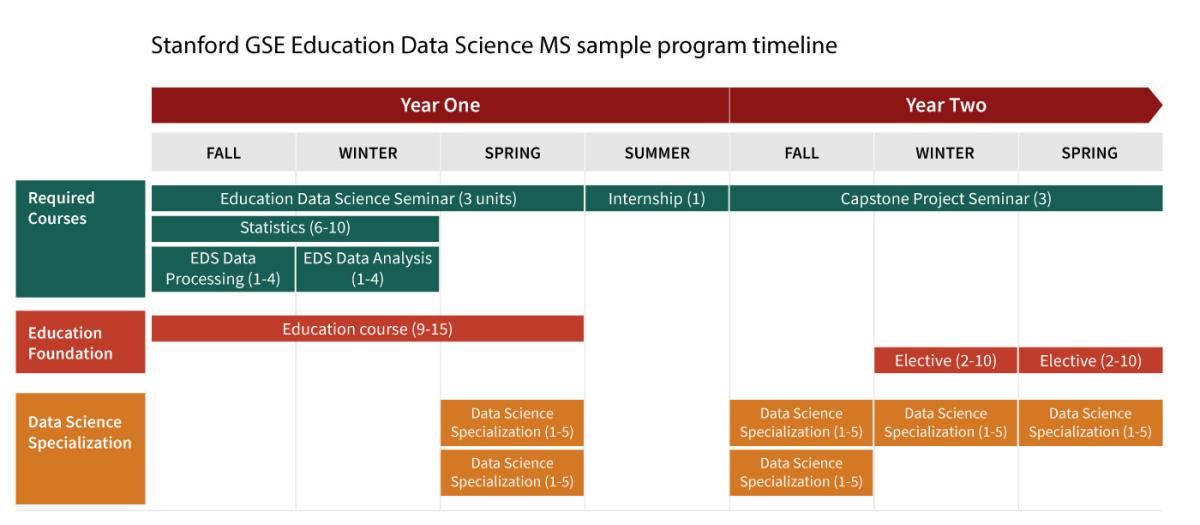
Students will take a minimum of 20 courses (51 units over 21 months) in order to complete their Education Data Science program. There are several requirements:
The goal of the EDS MS is to train the next generation of data scientists who have a substantive background and concern with educational topics. The requirements are aimed at accomplishing this goal, but we recognize students may come in with more developed skills and background in certain areas and more room to grow in others. As a result, it may be advisable for students to request changes to course requirements, substituting various courses and building expertise where needed so as to make sure the EDS program trains students to be the best education data scientists possible. To this end, students can propose substituting certain course requirements after discussion, review, and approval by the program director so as to make sure training goals are satisfied. Requests for substitutions should be made through a petition form.
Note: All course information is subject to change. Please consult Stanford Navigator and Axess for final course offerings.
The Education Internship Workshop (EDUC 215) is a course designed to support the EDS internship experience. Starting with a suitable internship agreement, students will explore personal learning goals, share experiences, reflect on their progress and development, and connect their internship to past and future academic coursework with fellow EDS and other GSE students.
Each quarter during the first year, students will enroll in a 1-3 unit seminar course (EDUC 259A-C) designed to introduce emerging topics in the field of education data science, review and discuss relevant developments and topics. The seminar includes community building, guest speakers, student-led programming and learning, and working towards an EDS Seminar Paper (first year). In the second year of the program, seminar sessions (EDUC 259D-F) will focus on student Capstone Projects, providing opportunities for collaboration and feedback, and time for final presentations of projects in the last quarter.
EDUC 423A "Introduction to Data Science: Data Processing" and EDUC 423B "Introduction to Data Science: Data Analysis" are a sequence of two courses that focus on working with education data. The first course focuses on how you can thoughtfully assess, manage, clean and represent data. The second course moves to an overview of various data science techniques to understand social phenomena (supervised and unsupervised learning). Students may substitute EDUC 423A and EDUC 423B with more advanced data science courses or more Education Foundation courses by petitioning a substitution request to the Program Director. This petition must be submitted before the start of EDUC 423A and EDUC 423B (Autumn and Winter Quarter of the first year, respectively). The petition can be found on the GSE's current student website.
Students will be required to take two courses in statistics in order to employ these analyses in their data science courses later in their course of study.
Introductory
Advanced
Students must develop domain expertise in education to be effective education data scientists. To this end, students will complete 3 education courses that ensure each student possesses knowledge of education theory and practice. For example, students may select courses that focus on areas like Education Policy and Analysis, Learning Sciences, or Assessment (among others). Students may design with consultation and approval from the program director a set of education courses that advance their intellectual goals.
Students must develop substantive breadth and depth in data science skills. To this end, students will complete three of five available tracks, each composed of two courses (see below). The areas of concentration offered are Natural Language Processing, Network Science, Experiments & Causal Methods, Measurement, and Learning Analytics. These courses are established courses at Stanford University and will allow for interprofessional education of GSE students and graduate students from other departments.
Introductory
Advanced
Introductory
Advanced
Introductory
Advanced
Introductory
Advanced
Introductory
Advanced
The rigorous course schedule for the Education Data Science program offers relatively little opportunity for selecting elective courses during the first year of the program; however, second year students are encouraged to select an elective course in each of their final two quarters. Students are encouraged to take courses within the GSE relevant to their capstone projects, specializations, or research interests.
Non-fluent speakers of English are strongly encouraged to take one of the following writing courses:
Students in the PhD program should contact:

Students in the POLS MA, MA/MPP, and undergraduate programs should contact:

Students in the EDS MS, IDMA, LDT MS, MA/JD, and PhD minor programs should contact:

Students in the GCE/IEPA MA and MA/MBA programs should contact:


© Stanford University, Stanford, California 94305 .